The Want-Ad Got Me In
Let me tell you the truth about how I found my “calling.”
In the fall of 1989, I opened the newspaper and found two want-ads sitting right next to each other.
One was for the police department.
The other said something along the lines of:
I applied to both.
There was no beam of light coming through the clouds. No distant sound of bagpipes. I didn’t stand up, place one hand over my heart, and announce that I had been chosen to serve mankind.
I needed a job.
The fire department called first.
That’s it. That’s the grand origin story.
Had somebody at the police department moved my application a little faster, Multiverse Officer Doss might be sitting somewhere today complaining that rookies don’t know how to write an incident report.
Instead, I received a letter telling me to report to the Nashville Fire Academy on March 16, 1990, at 0700.
It also made one thing very clear:
One minute late? Don’t bother showing up.
I showed up early.
And scared stiff.
Sixteen weeks later, they sent us onto the streets of Music City with patches on our shoulders, some basic training in our heads, and just enough confidence to be dangerous.
That want-ad got me into EMS.
But it wasn’t a calling yet.
We Throw That Word Around Too Easily
EMS folks love the word calling.
Sometimes we love it a little too much.
Put the word over a black-and-white picture of an ambulance, add a flag, a wolf, a heartbeat line, and somebody staring dramatically into the distance, and you have yourself a social media post.
Maybe throw in:
“Only a chosen few can do what we do.”
Bovine scatology.
Calling EMS a calling does not make us better than teachers, plumbers, accountants, nurses, truck drivers, police officers, or the woman working the overnight shift at Waffle House who can manage six angry drunks better than half the EMTs I’ve trained.
A calling is not a declaration of superiority.
It is not a request for applause.
And it damn sure isn’t an excuse to make the patch your entire personality.
The word should mean something—and you cannot know what it means until you know what the job costs.
The Calling Comes After You Know the Price
The academy does not tell you whether EMS is your calling.
Neither does EMT school.
Passing National Registry doesn’t tell you. Your first uniform doesn’t tell you. That shiny new stethoscope hanging around your neck like ceremonial jewelry certainly doesn’t tell you.
The job tells you.
It tells you after the novelty wears off.
It tells you when you’re stuck on a truck for twelve hours with a partner who complains about every patient, every nurse, every dispatcher, and every human being who has committed the unforgivable crime of needing an ambulance during their shift.
It tells you at 3 a.m. when you are dispatched for toe pain.
Yes, toe pain.
And before anybody starts—no, that patient does not deserve to be mocked or treated like an inconvenience. It may be routine to you. It may not feel routine to the frightened person who called.
You still have to assess them.
You still have to speak to them like a human being.
You still have to do your job.
The job tells you when dinner gets cold, your family celebrates without you, and another holiday is measured by what station you were assigned to instead of who was sitting around your table.
Then there are the calls that take more than a meal or a holiday.
The Christmas-morning pediatric code.
The call where everybody did everything they knew how to do—and it still wasn’t enough.
The face you remember years later, even when you cannot remember what you had for breakfast yesterday.
The calls that climb into the car with you after shift, follow you home, and sit quietly in the corner while you pretend everything is fine.
EMS will introduce you to boredom interrupted by chaos, questionable smells, bad coffee, worse management decisions, broken bodies, frightened families, and parts of yourself you may not particularly enjoy meeting.
It will also give you good partners who know when to talk, when to shut up, and when to quietly fix your mistake without making you feel two inches tall.
It will give you moments when your assessment was right, your treatment worked, and the patient got better.
It will give you quiet wins nobody will ever hear about.
Sometimes all you did was hold a hand, lower the fear in the room, or give somebody a little dignity during one of the worst days of their life.
Those count too.
Especially those.
Some People Simply Are Not Cut Out for This Work
Here is another truth EMS likes to avoid:
Some people simply are not cut out for this work.
That is not an insult.
It is not a character flaw.
It does not mean they are weak, stupid, lazy, or lesser human beings.
EMS requires an odd collection of traits. You have to function when the information is incomplete. You have to tolerate noise, smells, blood, bodily fluids, interrupted sleep, frightened families, unreasonable expectations, and occasionally unreasonable coworkers.
You have to make decisions, accept correction, control your own emotions, and communicate with people who may be scared, angry, intoxicated, confused, or dying.
Not everybody is built for that combination.
Some people try EMS, give it an honest effort, recognize it isn’t right for them, and move on.
Good for them.
Seriously.
It takes self-awareness to admit that something is not your work. Leaving EMS does not make someone a failure. Sometimes it is the healthiest and most professional decision they can make—for themselves, their partners, and their patients.
The world needs good people in thousands of other professions.
Go find the place where your abilities fit and do good work there.
What I cannot excuse is somebody realizing they hate EMS, resent the patients, refuse correction, and have no desire to improve—then staying another fifteen years because the patch has become their identity.
That doesn’t make EMS your calling.
Staying Comes With an Obligation
If you get through the bullshit, the bad partners, the 3 a.m. toe pain, the missed holidays, and the Christmas-morning pediatric code—and you still want to stay—then maybe, just maybe, it is a calling.
But being called to the work does not excuse you from being competent at it.
Quite the opposite.
If you choose to stay, then stay teachable.
Know your equipment, but don’t become dependent on it.
Know your protocols, but understand the reasoning behind them.
Take correction without treating every suggestion like a personal attack.
Write the chart as though the work matters.
Speak to your patients with compassion, respect, and dignity.
Be the partner people are relieved to see climbing into the truck.
You do not get to call EMS your calling and then perform it half-assed.
The word does not give you a halo.
It gives you a responsibility.
EMS Doesn’t Give Up Her Dead That Easy
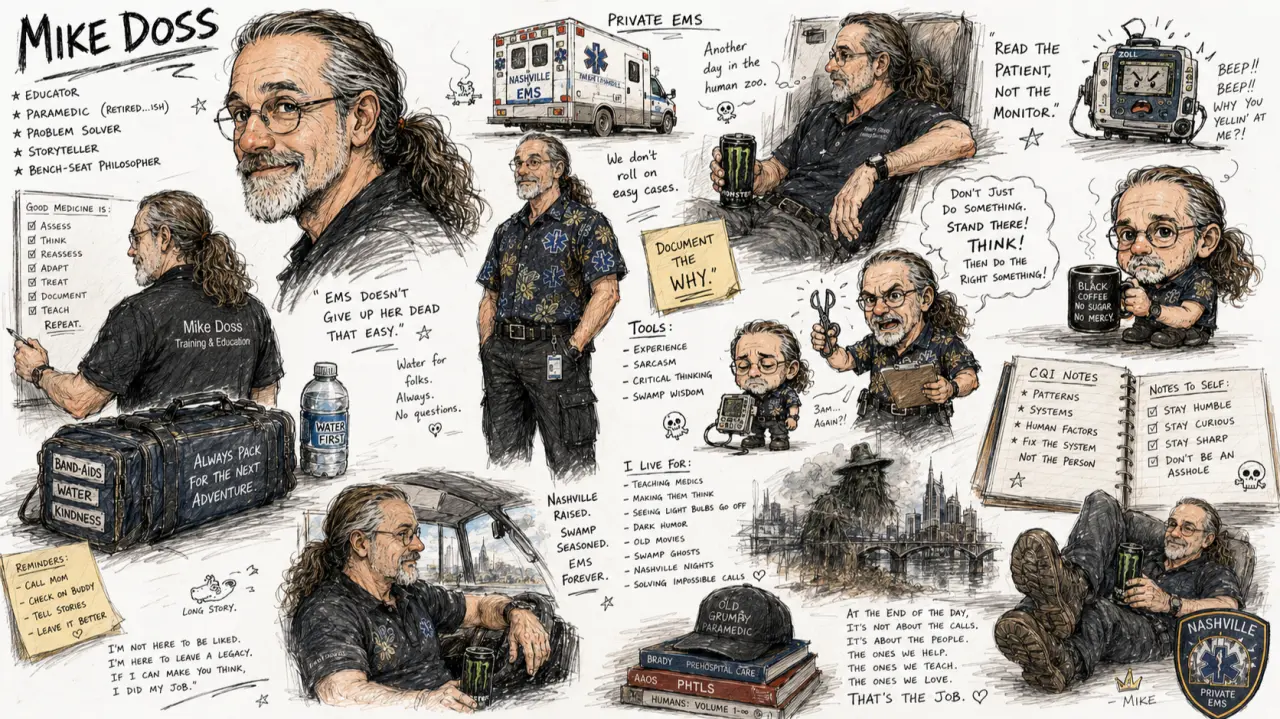
I retired from Nashville Fire in December 2022.
After more than three decades, PTSD, a worn-out back, and several long-term relationships with heating pads, I knew it was time to step away from the street.
I eventually found myself back in a classroom, working with new EMTs, experienced providers, and people trying to find their place in this strange profession.
The work changed.
The reason for doing it didn’t.
I still want providers to understand the “why,” not just memorize the “what.”
I still believe compassion, respect, and dignity matter as much as any skill printed on a competency sheet.
I still believe we should prepare people to perform—not just pass.
And I still believe the patient must be read before the monitor.
Not because I am some heroic, battle-forged, well-seasoned paramedic descending from the mountain with sacred EMS knowledge.
Dear Lord, spray me with a water bottle if I ever start talking like that.
I believe it because I stayed long enough to learn where the textbooks end and the responsibility begins.
The Bench Seat Lesson
I cannot honestly say EMS called to me in 1989.
I answered a newspaper ad.
The fire department called before the police department, and that administrative head start determined the next 32 years of my life.
But somewhere between the academy and retirement—between the nonsense and the heartbreak, the lousy partners and the excellent ones, the calls we laughed about and the ones we never discussed—the job became mine.
Not because I was chosen.
Because after learning exactly what the work demanded, I continued choosing it.
That is the difference.
The want-ad got me into EMS.
The calling is why I stayed.
See you on the bench seat.