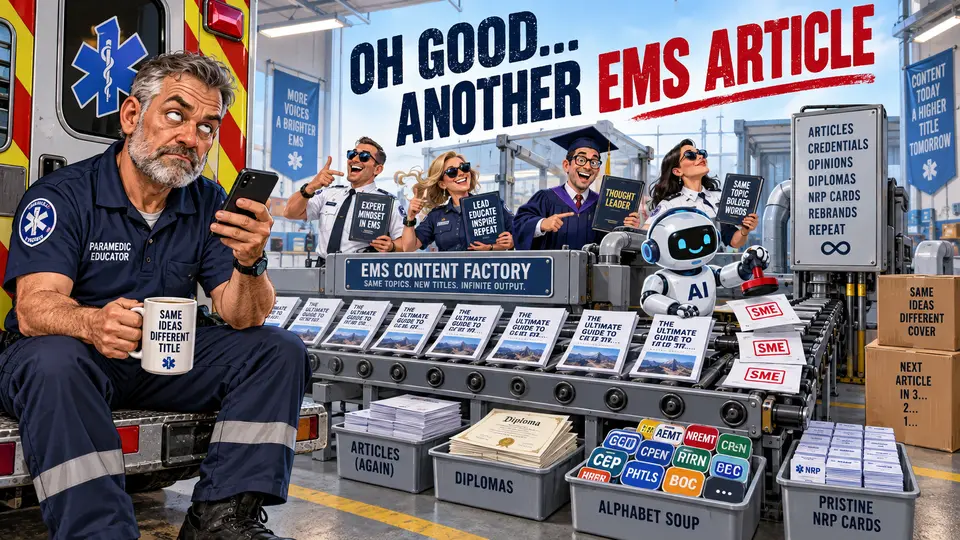
Spend ten minutes scrolling through EMS content on LinkedIn and tell me you don’t see it.
EMS is understaffed. EMS is underpaid. EMS is burned out.
We need more critical thinking, better simulation, stronger mentorship, improved leadership, greater resilience, meaningful clinical experiences, and—everybody say it together now—a complete reimagining of the future of EMS.
None of that is necessarily wrong.
But Lord have mercy, how many times can we reheat the same Sunday casserole and introduce it like nobody has ever seen cream-of-something soup before?
That is the problem.
We do not have a shortage of EMS educational content. We are drowning in it. Much of it is reasonably accurate and perfectly well-intentioned, but it is packaged, polished, and presented so similarly that even the good material has become part of the wallpaper.
The headlines are practically interchangeable:
- “Why ___ Matters.”
- “Five Ways to Improve ___.”
- “The Future of EMS.”
- “Are We Training or Educating?”
- “What Every EMS Leader Needs to Know.”
By the time the casual student, working provider, or exhausted educator finishes the headline, they already believe they know the rest.
They probably do.
So they scroll.
AI Put an SME Costume in Everybody’s Closet
Let me offer a backhanded compliment to artificial intelligence: it has given almost everyone the ability to sound like a subject-matter expert.
That is impressive.
It is also becoming a pain in the ass.
AI can organize information, clean up grammar, improve presentation, and help someone communicate a legitimate idea more effectively. I use it. Used properly, it is one hell of a tool.
But let’s not confuse the tool with the toolbox—or the toolbox with the mechanic.
AI cannot manufacture experience. It cannot replace the judgment earned by making decisions with incomplete information while a real patient is circling the drain. It has never missed a diagnosis, taken the ass-chewing, reviewed the call, learned from it, and climbed back into the truck the next morning.
It can explain shock.
It has never watched a patient compensate beautifully—right up until they didn’t.
It can write about leadership.
It has never tried to hold a scene together while an inexperienced partner froze, a family screamed, dispatch kept talking, and the nearest available help was twenty minutes away.
And some folks have become awfully fond of the costume.
The Alphabet Soup Is Getting Cold
Before somebody gets their doctoral hood in a wad, education matters.
Bachelor’s degrees matter. Master’s degrees matter. Doctorates matter. Research, educational theory, leadership, administration, and system-level thinking all matter.
An NRP credential matters too.
But they do not all mean the same damn thing.
A degree may demonstrate expertise in research, education, leadership, business, or administration. An NRP card demonstrates that someone met the certification requirements.
Neither one tells me how long that person actually worked as a paramedic, how recently they treated a patient, or whether they stayed long enough to develop the pattern recognition that cannot be downloaded, simulated, or printed on heavy card stock.
Having an NRP card in your pocket does not automatically mean you have done the job.
It means you qualified to do the job.
Those are not the same sentence.
And good on anyone willing to study EMS from the outside or add paramedic education to an already impressive résumé. We need educated voices. We need rigorous research. Sometimes the person looking down from 30,000 feet can see problems that those of us standing in the weeds cannot.
But EMS looks suspiciously tidy from 30,000 feet.
Come on down to the pavement, where your elegant educational theory has to survive an unreliable historian, a dark trailer, missing medication bottles, questionable vital signs, an unfamiliar partner, three relatives answering every question, no available supervisor, and an emergency department that would prefer you take the patient anywhere else.
The view changes considerably.
Sometimes We Promote Our Best People Right Out of the Job
There is another way people become disconnected from field medicine, and I have watched this one happen throughout my career.
Some of the best EMTs and paramedics I have known were promoted early because they were genuinely good at what they did.
They were dependable. Clinically sharp. Calm under pressure. Natural leaders.
The promotion was deserved.
Then we promptly pulled them away from patient care and buried them under scheduling, staffing, logistics, budgets, compliance reports, meetings, investigations, and personnel problems.
Congratulations—you were such a good paramedic that we have arranged for you to stop being one.
Over time, their understanding of field operations begins arriving through spreadsheets, complaints, dashboards, CQI reports, and conversations with crews instead of through the back doors of an ambulance.
That does not erase what they accomplished. It does not make them bad leaders or invalidate everything they know.
But we need to be honest about what kind of experience we are discussing.
Having worked as a paramedic is not always the same as currently doing the work.
Supervising paramedics is not the same as routinely making clinical decisions inside the truck.
A promotion may prove how good you were when you left the field. It does not magically keep you current ten years after you left it.
Protocols change. Equipment changes. Documentation multiplies like somebody fed it after midnight. Hospital relationships shift. Staffing gets thinner. Patient expectations evolve. The entire operational environment changes while the stories we tell in the classroom remain frozen in the year we last regularly touched a stretcher.
Old experience still contains wisdom.
It can also contain an expiration date.
The SME Hamster Wheel
Once someone becomes known as an EMS educator, leader, consultant, speaker, or subject-matter expert, another problem appears: they feel pressure to remain visible.
The algorithm wants another post.
The audience expects another lesson.
The title practically demands another authoritative opinion.
Nobody wants to look like they have fallen behind, become irrelevant, or wandered too far away from the subject that built their professional identity.
That is where SME imposter syndrome can become a hamster wheel.
You have to keep posting to prove that you are still relevant, but you may be increasingly removed from the work that made you relevant in the first place.
Fortunately, AI is standing nearby with another polished article about leadership, resilience, critical thinking, and the future of EMS.
Add a dramatic opening.
Sprinkle in a few buzzwords.
Finish with “What do you think?”
Post.
Repeat Thursday.
The content may be accurate, but accurate is a pretty low bar for expertise. A drug handbook is accurate. That does not mean I want it running my cardiac arrest.
Real expertise includes context, limitations, uncertainty, consequences, and the ability to say:
- “That is outside my current practice.”
- “The crews doing this every day know that part better than I do.”
- “My experience is valuable, but it may not reflect today’s field.”
- “I need to listen before I teach this.”
Those statements do not make someone look weak.
They make that person sound like somebody worth listening to.
We Have Created Educational Wallpaper
When every familiar observation is marketed as a revelation, every author is presented as an expert, and every post promises to transform EMS, readers begin protecting their attention.
The student scrolls past.
The medic between calls scrolls past.
The educator who has already seen four versions of the same post before breakfast scrolls past.
Eventually, genuinely important material gets ignored along with the rest.
That is the real cost of oversaturation.
Familiarity gets mistaken for mastery. We recognize the headline, assume we already understand the lesson, and keep moving—even though very little has changed where the work is actually being done.
The answer is not to stop writing.
It is not to stop pursuing degrees, conducting research, accepting promotions, or using AI.
The answer is to quit performing expertise and start showing our work.
Tell me what you personally observed.
Tell me when your field experience occurred.
Tell me whether you are describing current practice, previous practice, published evidence, or personal opinion.
Give me the patient, the mistake, the contradiction, the unintended consequence, or the policy that looked brilliant in the conference room and fell apart before the truck cleared the station.
Give the reader something beyond another polished confirmation of what EMS already believes about itself.
We do not need fewer educated people speaking about EMS.
We need more honesty about where their expertise comes from, how current it is, and where its limits begin.
Because when everybody is presented as a subject-matter expert, everybody eventually starts sounding the same.
And once that happens, nobody stops to listen.
The opinions expressed here are mine alone. They do not represent my employer, any agency I have worked for, or any professional organization foolish enough to let me remain a member.
This article is based on my personal experience from more than three decades in EMS and my continuing work in EMS education. Artificial intelligence was used as an editorial tool to help organize and polish the writing—which is either appropriate transparency or the punchline to the entire article. The observations, opinions, field experience, and occasional irritation remain entirely my own.