
I’m gonna skip the formal tone. You don’t need another polished memo. You need to hear what this actually sounds like from down here.
I’m sitting in the middle of this thing every day—between the people you’re hiring and the system you expect them to survive in. And right now, those two don’t match.
Not even close.
And before I go any further, let me be clear about where I’m standing.
I didn’t come up questioning this system.
I came up in it.
I stayed late without asking. Missed things I shouldn’t have missed. Took pride in being the one who didn’t complain, didn’t leave, didn’t say no. I laughed at the same questions these new hires are asking now.
I was part of that culture.
So this isn’t me pointing fingers from the outside.
This is me realizing—after enough years and enough miles—that just because we accepted it… doesn’t mean it was right.
And like any old dog, yeah… I’m learning a few new tricks.
The Question Everybody Laughs At
You’ve probably heard it already.
New EMT walks in, fresh license, still believes what we taught them, and asks:
“Do we get off on time?”
And somewhere in the room, someone laughs.
Hell, I used to be one the laughing.
Because we already know the answer.
But that question isn’t about the clock.
Let me say this real clear:
These new providers are not soft.
They’re not lazy. They’re not allergic to hard work.
They’re just not interested in being quietly ground down while everyone pretends that’s normal.
And if I’m being honest… they’ve got a point.
The Disconnect We Built Ourselves
Here’s the disconnect we helped build—whether we meant to or not.
We trained them in a system where details matter.
Every step. Every reassessment. Every decision accounted for. Miss something, you fail. That’s the standard we set.
Clean. Structured. Accountable.
That’s what we told them this job was.
Then we drop them into an operation that runs on chaos, late calls, and “that’s just how it is.”
We expect discipline in patient care…
…and indifference when it comes to their own time.
That contradiction isn’t subtle.
They see it immediately.
Why Doesn’t Leadership Have to Stay Current, Too?
How did we get here? Welp…
A lot of the leadership in this field didn’t get here because they were formally trained to lead.
They got there because they stayed.
They outlasted the people who burned out, moved on, or couldn’t keep absorbing the cost.
And seniority matters. I’ll be the first one to defend that. Time on the truck teaches things no classroom ever will.
But time alone doesn’t teach leadership.
And it definitely doesn’t keep leadership current.
We expect our street providers to stay sharp.
New protocols come out? They learn them.
AHA updates drop? They adjust.
Assessment standards change? They adapt.
Nobody argues that. It’s part of being a professional.
So here’s the million dollar question—
Why doesn’t that same expectation apply to leadership?
Why are we comfortable with managers and supervisors operating off what they learned 10 or 15 years ago about staffing, scheduling, communication, and people? (Or nothing at all)
Why is continuing education expected for patient care…
…but optional—or nonexistent—when it comes to managing the people providing that care?
Because right now, that gap is showing.
And the new generation sees it faster than we did.
Try Asking Them Back
When a 20-something EMT asks:
“How does this company support work/life balance?”
That’s not a challenge.
That’s an opening.
Instead of shutting it down—or laughing it off—try asking them back:
“How do you think we should?”
Let them answer.
Because they might give you something we haven’t thought of yet.
Not because they understand the job better…
…but because they’re not carrying the same assumptions we’ve been holding onto for years.
I’m not saying every idea they have will work.
This job is still unpredictable. It still runs long. Emergencies don’t respect the clock.
I’m not asking you to change that reality.
I’m asking you to stop avoiding the conversation about everything around it.
Where the Exit Starts
From where I sit, here’s what I’m watching happen:
New hires come in motivated. Engaged. Ready to work.
Then they start seeing the gap.
Between what we taught them…
…and what we tolerate.
They notice how often people stay late.
They notice how casually we brush it off.
They notice the tone when someone asks a reasonable question and gets a laugh instead of an answer.
I know that tone. I’ve used that tone.
And that’s the moment they give us the side-eye and wonder if this is the place for them.
Not dramatically. Not all at once. Just enough.
They stop leaning in as much. They stop buying in the same way.
And eventually, some of them start looking for the exit even before orientation is over.
You want to talk retention?
It starts right there.
Not with pay scales. Not with incentives.
Right now, we’re not giving them a good reason to believe that.
Actionable Takeaway
This isn’t about making EMS easier.
It’s about making it sustainable.
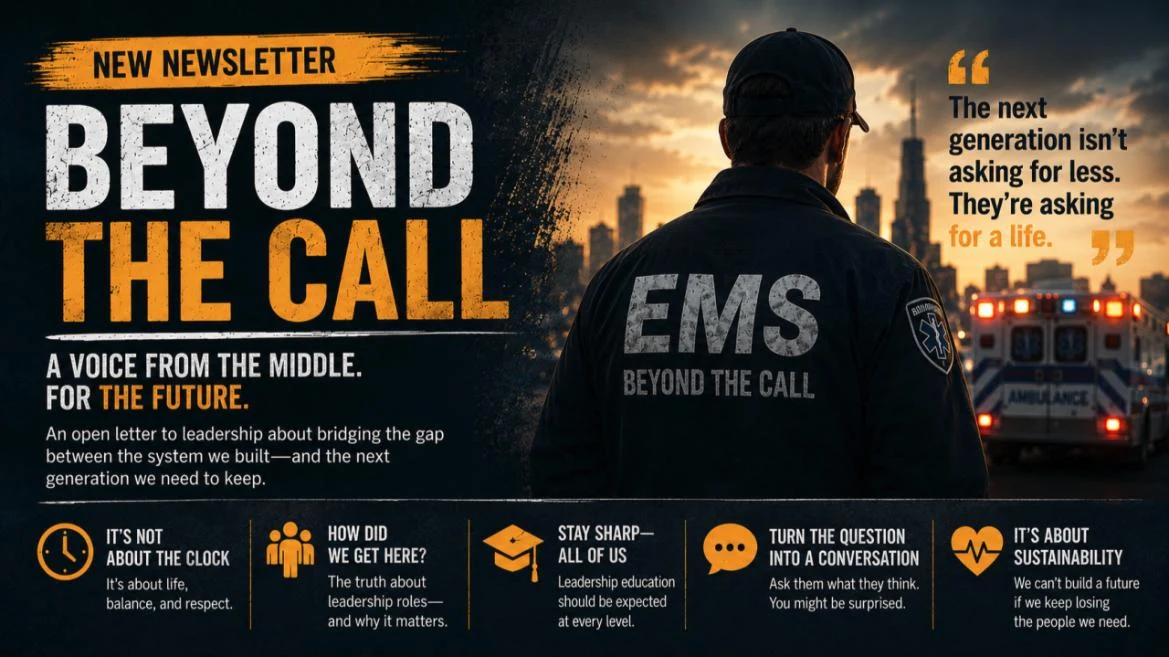
Because the next generation isn’t asking for less responsibility.
They’re asking if this career can coexist with a life.
And if the only answer we give them is silence—or laughter—
they’re going to find that balance somewhere else.
I didn’t always see it this way.
But I do now.
And from where I sit in the middle of this…
we don’t have as much time to figure it out as we think.