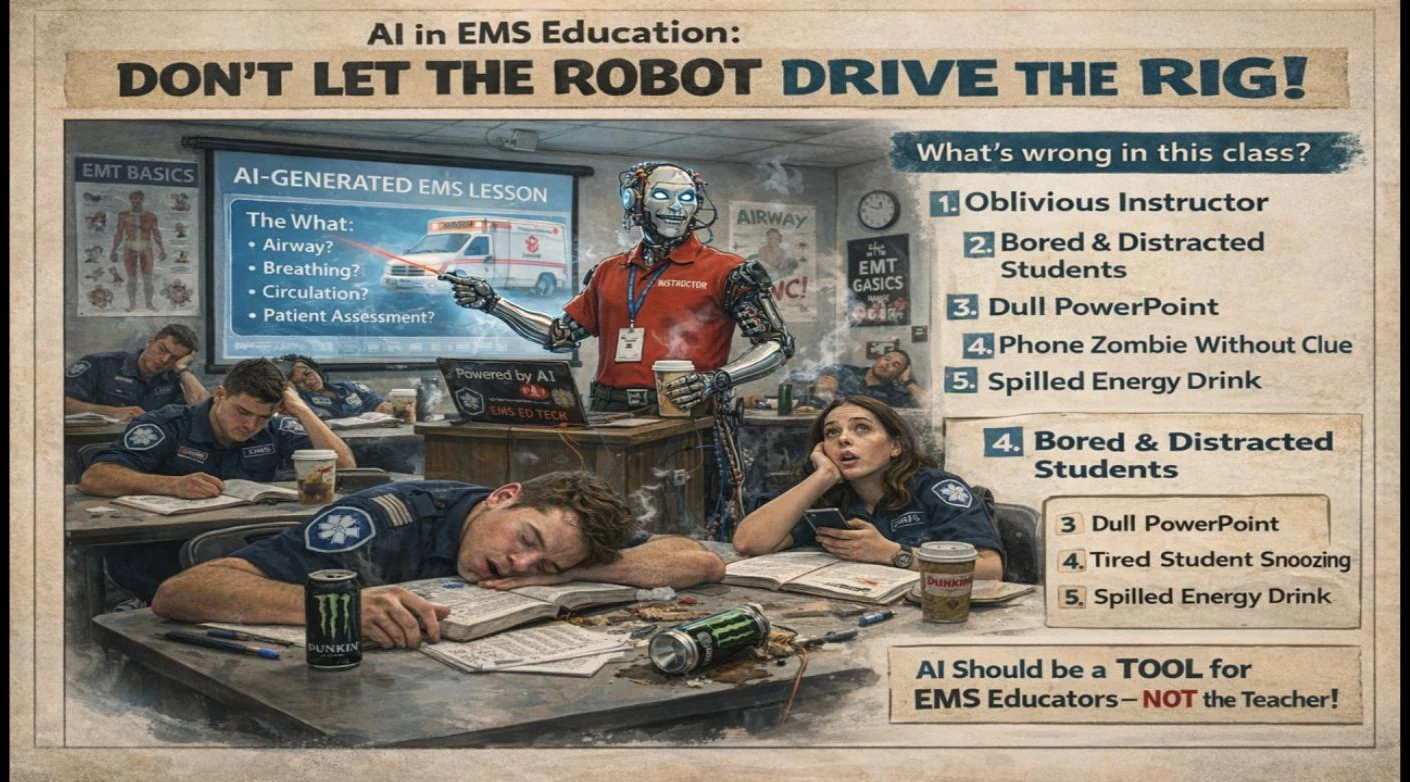
New instructors—yeah, you. With the lanyard. Let’s have a chat.
Congrats on being an EMS educator. For real. We need you.
But if you’ve got more certs than street time and your plan is to have AI crank out your slides, then you stand up front and read them word-for-word like you’re narrating a nature documentary?
Nope.
That’s not teaching. That’s content delivery. That’s a podcast with eye contact.
What AI Is Actually Good For
AI can absolutely help you spit out scenario variations until your students can do OPQRST in their sleep, generate quiz banks so you’re not writing fifty questions at midnight like a raccoon in a trash can, build remediation drills for the students who need the same concept explained five different ways, and give “practice patient” dialogue so students can rehearse interviewing without you playing confused-chest-pain-guy for the thousandth time.
All good. Legit good.
But here’s the trap. It’s the new PowerPoint. PowerPoint didn’t ruin education because slides are evil—it ruined education because instructors started confusing “I covered it” with “they learned it.”
AI will let you make ninety-slide decks, “interactive modules,” discussion prompts, study guides, and competency checklists in the time it takes me to crack a Monster and regret my life choices. And you’ll feel so accomplished. Meanwhile your students are sitting there thinking, “Cool. So when do we learn how to not screw this up in real life?”
Stop reading your slides. Your students can read. Teach them the why. Teach them the when. Teach them the holy grail: when not to.
AI Can’t Read the Room
EMS is not a trivia sport. It’s decision-making when things are loud and messy and somebody’s mom is crying in your ear.
AI can’t teach the room. It can’t smell a classroom. It can’t see that one student in the back with the “I’m lost but I’m pretending” face. It can’t feel the moment your class mentally checks out and you need to switch gears right now. It can’t hear the difference between confidence and parroting.
A real instructor reads a room like vitals: glazed eyes means overload, too much joking means anxiety, dead quiet means you lost them, too much nodding means they’re faking it. AI can’t do that. A human can.
And a good educator can call an audible and make the lesson real: “Forget the slide—here’s what this looks like at 03:30 in a hoarder house with cat pee in the air and a COPD patient tripod-ing like a busted lawn chair.” That’s when students learn. That’s when the textbook becomes a patient.
AI Can List the Steps. It Can’t Build Judgment.
Students love the “what.” It’s neat. It’s checklisty. It feels safe. But EMS is mostly what’s going to kill them first, what matters most, what you’re not doing, what you’re watching, what you’re reassessing, and what you’re leaving alone because messing with it will make it worse. That’s judgment. That’s the job.
AI can tell you “give oxygen.” Students love oxygen—they’ll throw O2 on a paper cut if you let ‘em. Your job is teaching when it matters, when it doesn’t, and when it’s a comfort blanket because they’re scared to think.
Same with skill sheets and mandatory actions. Those aren’t there to be mean. They’re there because missing basic safety stuff gets patients hurt and gets candidates failed. The boring items—PPE, reassessment, contraindications, sequence, not doing harm—are exactly what people skip when they get rattled. AI can print the list. It can’t watch a student’s hands shake and say, “Slow down. You’re task-fixating. You’re treating the checklist, not the patient.”
And Now, Seasoned Instructors—Yeah, You Too
Before the old heads start smirking like “See? Told ya these new kids are gonna ruin everything”—stop.
I’ve watched seasoned instructors mess this up from the other direction. Sitting there arms crossed like AI personally keyed your truck. Full-on get-off-my-lawn energy. You’ve seen fads come and go. You’ve watched admin chase shiny nonsense because it’s cheap and measurable. So you don’t trust AI. Fair.
But refusing AI out of principle? That’s just the newbie mistake in reverse. Same problem, different outfit.
Here’s the truth you already know deep down: AI isn’t coming for your job… unless you hand it over. If the good instructors refuse to touch it, the people who will use it are the lazy ones. And then it becomes exactly what you’re afraid of—a content factory that produces “graduates” who can pass a quiz and freeze on a real call.
So don’t boycott it. Own it. Supervise it.
Treat It Like a New Partner
Treat AI like a brand-new EMT partner: eager, fast, occasionally full of confident nonsense. You don’t let the new EMT run the whole call unsupervised. Same deal.
Let AI do the grind work—scenario variations, quiz banks, alternate explanations, remediation prompts, roleplay scripts. Then you do what it can’t: teach judgment, teach priorities, teach presence, teach the why and when and when-not-to, and run honest debriefs that actually sting a little, because that’s where learning lives.
Bottom Line
AI is a tool. A solid one. But it’s not a teacher.
If you’re new: don’t use AI to cover for lack of street seasoning. Use it to save time and create reps, then lean on mentors and ride time for what a robot can’t give you.
If you’re seasoned: don’t act like ignoring it is “principled.” That’s just stubborn. Learn it enough to control it, so it doesn’t control your program.
Because dispatch doesn’t care how pretty your AI-generated module was when the patient’s turning gray and you’ve got ninety seconds to make a decision.
—OGP