You haven’t even put the truck in park yet.
Someone’s already running across the yard waving their arms like they’re trying to land a helicopter.
“OVER HERE! OVER HERE!”
You open the door and they’re in your face.
“She’s in there! She can’t breathe! Follow me! COME ON! Why aren’t you running?!”
They spin around and bolt toward the house, looking back every few steps like you’re moving in slow motion.
And yeah… every new provider feels that surge of adrenaline.
That urge to sprint.
To react.
To match the panic.
But the experienced providers know something important:
If you let that energy become your energy, the call starts going sideways before you even reach the front door.
Then You Walk Into the House
And it gets worse. The smell hits first.
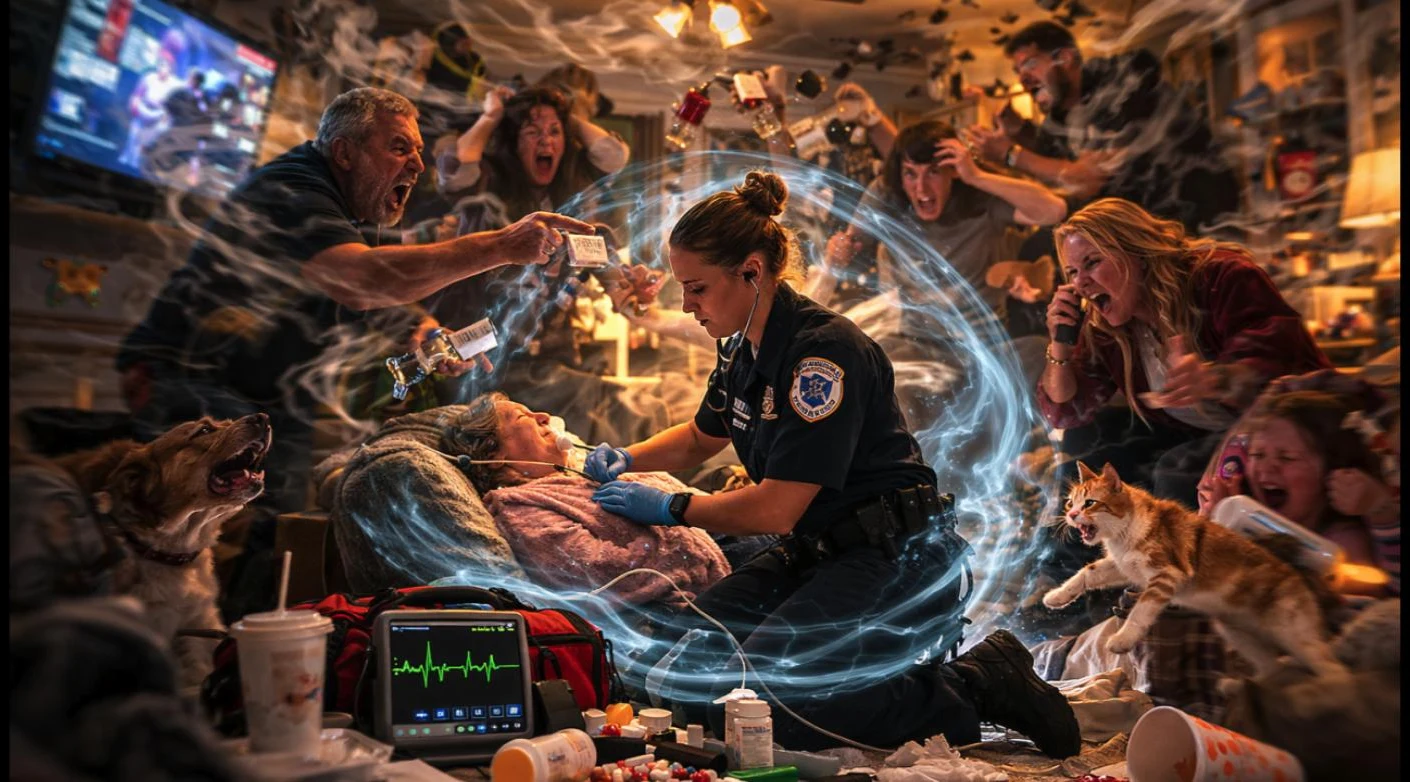
Cat pee. Stale cigarettes. A TV screaming in the corner. Five people talking over each other. Someone crying. Someone pacing. Someone shoving pill bottles toward you.
Then a voice from the back of the room: “Took you long enough.”
Another voice: “She’s been like this for ten minutes!”
And somewhere in the middle of that chaos is your patient—half slumped on a couch while the entire room spirals around them.
Here’s the truth nobody explains well in EMT class:
The loudest thing on most EMS calls isn’t the siren.
It’s the room.
And if you’re new, that chaos will try to pull you into it.
Talking louder. Moving faster. Reacting instead of thinking.
But the providers who last in this job learn something early:
You don’t match the chaos. You control it.
Step One: Control Yourself First
Before you ask a single question, pause.
Just for a moment. Look at the patient. Scan the room. Take one breath.
That small pause lets your brain catch up with what you’re seeing.
You’re already performing your scene size-up and primary assessment anyway — safety, number of patients, airway, breathing, circulation.
More importantly, it stops you from getting pulled into the emotional tornado around you.
If you rush in frantic, the room stays frantic.
If you walk in calm… the room starts adjusting to you.
Step Two: Never Ask the Whole Room
One of the fastest ways to lose control of a scene is asking:
“Can someone tell me what happened?”
Sounds reasonable.
But what actually happens?
Everyone talks.
Daughter yelling about chest pain. Neighbor talking about medications. Grandson shouting something about diabetes. Someone in the kitchen yelling about a fall last week.
Now you’ve got five historians and zero useful information.
Instead, point.
“Sir — you in the blue shirt. Tell me what happened.”
Now the room has direction. One voice. One timeline.
Meanwhile you’re still watching the patient — breathing, skin color, mental status — the things that actually tell you how serious the situation is.
Step Three: Give the Crowd Something to Do
Crowds get loud when they feel helpless.
Give them jobs.
“Ma’am, can you grab her medication bottles?” “Sir, can you unlock the front door for our stretcher?” “Can someone turn that TV down?”
Now they’re part of the solution instead of part of the noise.
And you can actually work.
Step Four: Lower Your Voice
Here’s a trick that feels backwards when you’re new.
When the room gets louder…
you get quieter.
Slow your voice. Speak calmly.
“Alright folks… give us just a little space so we can help her.”
People naturally quiet down when someone speaks calmly during chaos.
Yelling just adds another voice to the storm.
Step Five: When Your Human Side Shows
EMS shifts are long.
You’ll be tired. Hungry. Maybe running on gas-station coffee and poor life choices.
Eventually someone says the wrong thing at the wrong time.
A family member blames you. Someone complains you took too long. A nurse snaps at you during report.
And sometimes… you snap back.
It happens.
But professionalism isn’t about never making mistakes.
It’s about what you do next.
Own it.
“Hey… that came out wrong. I’m sorry. Let’s reset and start over.”
Then refocus on the patient.
Because even in evaluation scenarios, unprofessional behavior can be a critical failure if it isn’t corrected.
But more importantly—it’s just part of being a decent human during someone’s worst day.
Quick Takeaways for Your Next Call
When a scene gets loud or chaotic, remember this: pause before speaking. Pick one historian — don’t ask the whole room. Lower your voice instead of raising it. Give bystanders small tasks. Control the space around the patient. And if you lose your cool, apologize and reset.
None of this requires special equipment.
Just awareness… and practice.
Now I Want to Hear From You
If you’ve been on the truck for more than a few shifts, you’ve seen one of these scenes.
Maybe it went smoothly. Maybe it turned into absolute chaos.
Maybe you asked the whole room what happened and instantly regretted it when everyone started yelling at once.
We’ve all done it.
So I’m curious: what’s a call where the scene got loud or chaotic? What worked? What didn’t? And if it went sideways… what did you do differently next time?
The good stories help rookies.
The bad stories help them even more.
Because nobody walks into this job already knowing how to manage a room full of scared humans.
We learn it the same way we learn everything else in EMS.
One messy call at a time.