Abstract
Emergency medical services education is structured around progressive certification levels, each introducing increasing clinical responsibility, knowledge, psychomotor complexity, and decision-making expectations. Advancement, however, should not be equated with mastery of foundational competencies developed at earlier levels.
Cognitive load theory describes working memory as limited and recognizes that the development and organization of knowledge in long-term memory can decrease the cognitive resources required to manage familiar information and tasks.[1,2] Deliberate-practice literature further supports structured repetition accompanied by defined objectives, feedback, reflection, correction, and continued performance improvement rather than reliance upon experience alone.[3]
Simulation-based mastery learning has also demonstrated meaningful improvements in clinical skill acquisition when learners are expected to achieve defined performance standards rather than simply complete a predetermined amount of instructional time.[4]
Expert clinical performance should not, however, be interpreted as thoughtless automaticity. Research examining expert judgment describes the importance of recognizing situations in which relatively automatic processing must give way to more deliberate and effortful cognition—described by Moulton and colleagues as “slowing down when you should.”[5,6]
For EMS education, these concepts suggest a straightforward principle: advanced clinical reasoning is easier to develop when foundational skills are sufficiently reliable that their mechanics no longer consume a disproportionate share of the clinician’s available cognitive resources.
The educational objective should therefore be more than progression toward the next certification level. It should be the development of clinicians whose foundational skills are sufficiently established to support increasingly complex assessment, interpretation, anticipation, and clinical judgment.
Okay. Enough With the Pretty Words.
Cognitive load theory. Automaticity. Deliberate practice.
Mastery learning. Working memory. Clinical reasoning.
Now let’s go to work.
Your patient isn’t lying on a simulation table in a climate-controlled classroom.
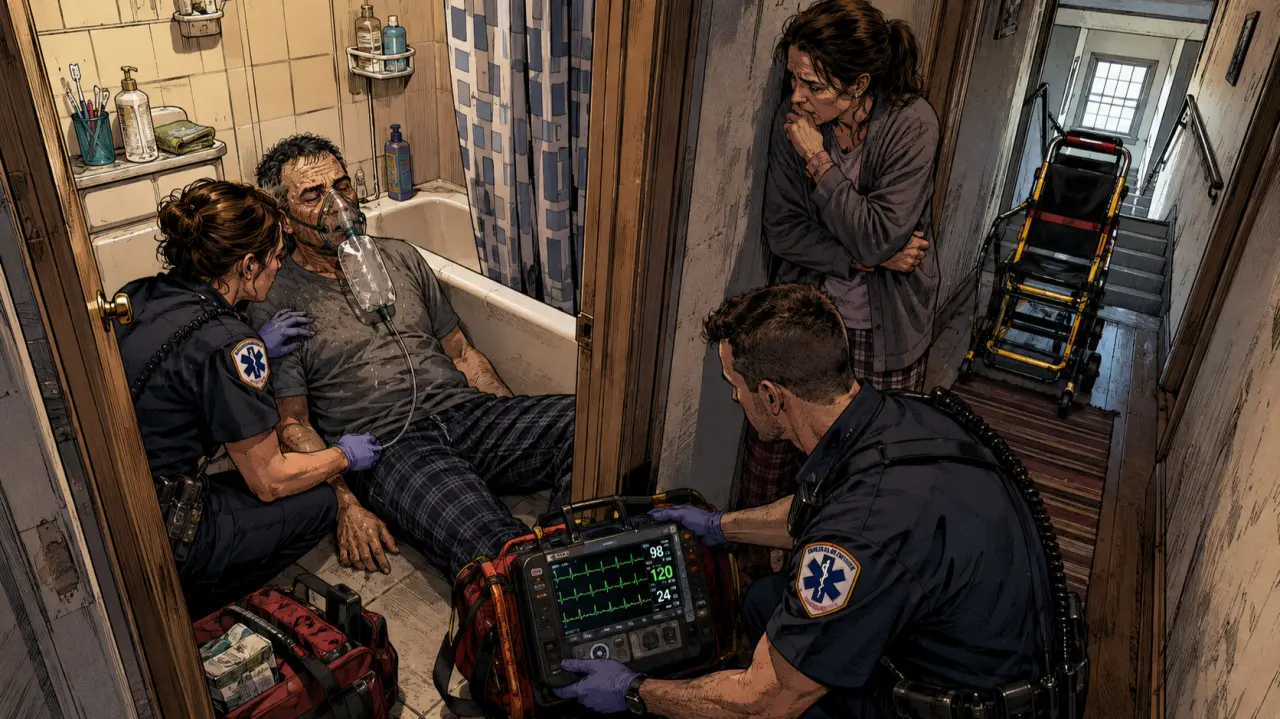
He’s wedged between the toilet and the bathtub. He’s 280 pounds.
The bathroom is about the size of a small closet. Because they always are.
His wife is standing in the doorway saying, “He’s never acted like this before.” Your partner is trying to get a blood pressure while straddling a trash can.
The monitor is in the hallway because there isn’t room to bring it inside.
The oxygen bag is downstairs. The stair chair is three flights below you.
The patient is diaphoretic, breathing 32 times a minute, and keeps telling everybody he’s fine.
Now tell me how much available brainpower you’d like to spend remembering how to use the blood-pressure cuff.
That’s what this paper is about.
The Basics Have to Become Boring
Working memory is limited.[1,2]
That isn’t an EMS opinion. That’s how the system works.
When you’re brand new, everything consumes attention.
Where does the cuff go? Which way does the tubing face?
Where do I put the stethoscope? Do I count respirations for 30 seconds or 60?
How do I turn this regulator on? Where does the nasal cannula connect?
Which button gives me a 12-lead? How do I drop the stretcher?
Where does this strap go?
That’s normal. Nobody crawls out of EMT school looking like they’ve been doing this for twenty years.
But sooner or later, the basic mechanics have to stop eating your entire brain.
Because if you’re standing over a sick patient thinking:
Okay... cuff... cuff... where’s the cuff...
you’re not thinking:
Why is his skin gray?
Why does he keep trying to sit upright?
Why is his respiratory rate climbing?
Why does his wife look terrified when he’s telling me he’s fine?
Those are better questions.
And you don’t get to those questions very well until the mechanics stop taking up the whole damn room.
Welcome to the Bathroom Call
Let’s keep this in the real world.
Patient down in the bathroom. Between the toilet and the tub.
Third floor. Narrow hallway. Family everywhere.
No good place to stand. No good place to put equipment.
Maybe one person can fit in the room comfortably.
Everything else happens from the doorway.
This is where the classroom ends and EMS starts.
The patient isn’t positioned correctly. The lighting sucks. You can’t stand where you want to stand. Your gear is split between rooms.
The patient keeps moving. Somebody is crying.
Somebody else is asking questions. Your radio is chirping.
And now you’ve got to decide:
Do I treat here? Do I move first? Can I safely move first?
Can the patient tolerate three flights of stairs? Do I need more people?
Do I need oxygen before we move? Do I need CPAP before we move?
What happens if he deteriorates halfway down the stairwell?
That is cognitive load. Not the pretty academic version.
The sweaty version. And every basic task that still requires full conscious attention takes something away from your ability to manage the bigger problem.
Repetition Matters—But Bad Repetition Still Counts
Deliberate practice is not just doing something over and over again.
It involves focused tasks, feedback, correction, reflection, and repeated attempts to improve.[3]
That matters because experience alone does not equal expertise.
You can repeat good technique. You can repeat bad technique.
Both can become familiar.
There is a huge difference between:
“I’ve been doing this for twenty years.”
and:
“I’ve spent twenty years getting better at doing this.”
Those are not the same sentence.
If you’ve taken a blood pressure incorrectly 500 times, you haven’t achieved mastery.
You’ve just gotten really damn efficient at being wrong.
Practice matters. Feedback matters. Correction matters.
Then you do it again.
The Classroom Can Teach the Skill. Reality Tests It.
Simulation works.
Mastery learning works.
The literature supports both.[4,8]
Good simulation lets us slow things down, isolate a skill, repeat it, correct errors, and build confidence without risking a patient.
That’s important.
But there are things a classroom can’t reproduce completely.
A mannequin doesn’t weigh 300 pounds. It doesn’t fall between the toilet and the bathtub. It doesn’t live on the third floor. It doesn’t get diaphoretic. It doesn’t vomit.
Its veins don’t disappear when you touch them.
Its daughter doesn’t stand six inches from your shoulder asking whether Mom is going to die.
And the mannequin damn sure doesn’t hit a pothole.
Eventually, the skill has to survive contact with reality.
That’s why time in the back of the ambulance matters.
The classroom introduces the skill.
Practice develops the skill.
The field teaches you whether you actually own it.
Make Room for the Medicine
Research has shown that increasing technical proficiency can reduce the attentional resources required for task execution, leaving more capacity available for other demands.[7]
That’s exactly what we want.
Not mindless performance. Not cowboy medicine. Not “I’ve done this forever.”
We want room in the brain.
You’re putting the monitor on. Your partner is getting vitals. You’re talking to the patient. You’re watching the respiratory pattern. You’re looking at skin color. You’re watching the family.
You’re thinking about the stairs. You’re deciding whether this patient can tolerate movement.
You’re wondering whether treatment needs to happen before you move or after.
That’s clinical reasoning.
If putting on the monitor requires all of your attention, you’re not watching the patient.
If setting up oxygen requires all of your attention, you’re not watching the patient.
If moving the stretcher requires all of your attention, you’re not watching the patient.
Eventually, those mechanics need to become background processes.
The Patch Does Not Replace the Foundation
EMS loves its certificates and liceneses.
EMT. AEMT. Paramedic.
Critical care. Flight. Instructor.
Whatever.
Advance. Learn. Grow.
I’m all for it.
But don’t confuse moving up with leaving the old stuff behind.
Cognitive-load theory supports building increasingly complex learning on previously established knowledge structures.[1,2]
The new level should sit on top of the old one.
It doesn’t replace it.
If you’re a paramedic and you can’t take a reliable manual blood pressure, I don’t care how pretty your 12-lead interpretation is.
If you can intubate but can’t ventilate effectively with a BVM, we have a problem.
If you can recite 40 medications but can’t perform a basic patient assessment without staring at a checklist, we have a problem.
The advanced skill does not erase the basic one.
It depends on it.
A paramedic should not stop being an EMT. They should become a damn good EMT with more knowledge, more tools, and more responsibility.
Sometimes the Best Next Course Is More Calls
There is a point where advancing too fast becomes its own problem.
If the learner is still using most of their attention for basic assessment, equipment operation, routine procedures, communication, movement, or documentation, adding another layer of complexity increases the number of things competing for the same limited working memory.[1,2]
Mastery-learning approaches recognize that not everybody reaches competence on the same clock.[4]
Some people need more repetitions.
That’s not failure.
Sometimes the answer is not:
Take another certification course.
Sometimes the answer is:
Go work some actual calls.
Take blood pressures. Move patients. Set up oxygen. Give reports. Do assessments.
Write charts. Listen to lungs. Talk to sick people. Get comfortable in the patient compartment.
Make the basic stuff boring.
There is nothing insulting about telling somebody they need more repetitions before adding another level of clinical responsibility.
That’s not gatekeeping.
That’s building the foundation before somebody tries to put another floor on top of it.
Automaticity Is Not Autopilot
This is where people can screw up the entire concept.
Experienced clinicians often perform familiar tasks with less conscious effort than novices.
That is useful.
But expertise is not staying in automatic mode forever.
Moulton and colleagues describe expert performance as including the ability to recognize when routine processing is no longer sufficient and shift back toward deliberate, effortful thought—what they called “slowing down when you should.”[5,6]
That’s the important part.
Two medics can walk into the same bathroom call.
Both have seen shortness of breath a thousand times.
Both know how to put on a monitor. Both know how to give oxygen.
Both know how to move a patient.
One sees:
“Another COPD patient.”
The other notices:
He won’t lie back. He’s bracing himself. His wife says this came on suddenly.
He’s soaked in sweat. His respiratory rate is climbing.
And the pulse ox looks way too pretty for how bad he looks.
One medic runs the usual program.
The other says:
“Something doesn’t fit.”
Same patch. Same years. Different level of attention.
That’s the difference between automaticity and autopilot.
The Goal Is Reserve Capacity
This may be the entire paper in one line:
The basic mechanics become efficient enough that your attention is available when the call gets ugly.
Like when the patient deteriorates halfway down the stairs. Now he’s less responsive.
Now his respiratory pattern changes. Now your carefully planned movement has become a medical emergency inside a stairwell.
This is not the moment to mentally search for the BVM.
This is not the moment to remember how the oxygen regulator works.
This is not the moment to figure out how the stair chair releases.
Your hands better already know that stuff.
Because your brain has another job now.
Teach the Next Level From the Last One
This changes how we should teach, too.
Stop acting like every new certification level wipes the learner’s hard drive.
If you’re teaching an EMT moving to AEMT, use the EMT foundation.
If you’re teaching an AEMT moving to paramedic, use the AEMT foundation.
Start with what they already know.
Then add depth.
Then complexity.
Then judgment.
Don’t say:
“Forget what you learned before. Now you’re doing paramedic medicine.”
That’s nonsense.
Say:
“You already know how to assess this patient. Show me.”
Good.
Now:
“What changed?”
Good.
“What does that mean?”
Better.
“What are you going to do?”
Good.
“What if that doesn’t work?”
There we go.
Now we’re teaching medicine.
The skill level changes.
The foundation remains.
Mam’aw Had a Word for Part of This
My grandmother—Mam’aw—used a phrase I remember as:
“Psy-fogging around.”
Maybe it was psy. Maybe it was sigh. Maybe there was never an official spelling.
I don’t know.
What I remember is the context.
She’d be cutting potatoes.
Pulling weeds.
Doing some repetitive chore she’d probably done thousands of times.
Her hands were working.
The job was getting done.
But the mechanics didn’t require her entire conscious attention anymore.
Her hands knew the work.
I didn’t know anything about cognitive load theory then.
I didn’t know anything about automatic processing, deliberate practice, or mastery learning.
She probably didn’t either.
But decades later, I understand what I was seeing.
Her hands knew how to do the job well enough that her mind had room for something else.
Thirty-two years in the back of an ambulance eventually taught me the same lesson.
Practice the foundational things until your hands know them.
Practice until the mechanics don’t require a committee meeting in your head.
Then keep your brain available.
Because eventually you’re going to find somebody wedged between the toilet and the bathtub on the third floor who is about to ruin your whole afternoon.
And when that happens, you better hope the basics already live in your hands.
And for My TL;DR Crowd
Master the level you’re at before you’re in a hurry to become the next one.
Get repetitions.
Work calls. Touch patients. Practice the skills. Accept correction.
Then do it again. Make the basics boring.
Build every new level on the one underneath it.
Don’t mistake certification for mastery.
Don’t mistake automaticity for complacency.
And if you’re teaching, don’t pile advanced material onto a foundation that’s still moving.
The literature calls pieces of this cognitive load, deliberate practice, mastery learning, automatic processing, and expert judgment.[1–7]
The back-of-the-unit version is shorter:
Master the mechanics.
Save the brainpower.
You’re going to need it.
References
- van Merriënboer JJG, Sweller J. Cognitive load theory in health professional education: design principles and strategies. Medical Education. 2010;44(1):85–93. doi:10.1111/j.1365-2923.2009.03498.x.
- Young JQ, Van Merriënboer J, Durning S, Ten Cate O. Cognitive Load Theory: implications for medical education: AMEE Guide No. 86. Medical Teacher. 2014;36(5):371–384. PMID: 24593808.
- Moulaert V, Verwijnen MGM, Rikers R, Scherpbier AJJA. The effects of deliberate practice in undergraduate medical education. Medical Education. 2004;38(10):1044–1052. PMID: 15461649.
- Cook DA, Brydges R, Zendejas B, Hamstra SJ, Hatala R. Mastery learning for health professionals using technology-enhanced simulation: a systematic review and meta-analysis. Academic Medicine. 2013;88(8):1178–1186. PMID: 23807104.
- Moulton CAE, Regehr G, Mylopoulos M, MacRae HM. Slowing down when you should: a new model of expert judgment. Academic Medicine. 2007;82(10 Suppl):S109–S116. PMID: 17895673.
- Moulton CAE, Regehr G, Lingard L, Merritt C, MacRae H. “Slowing down when you should”: initiators and influences of the transition from the routine to the effortful. Journal of Gastrointestinal Surgery. 2010;14(6):1019–1026. PMID: 20309647.
- Kurahashi AM, Harvey A, MacRae H, Moulton CAE, Dubrowski A. Technical skill training improves the ability to learn. Surgery. 2011. PMID: 20430409.
- Cook DA, Hatala R, Brydges R, et al. Technology-enhanced simulation for health professions education: a systematic review and meta-analysis. JAMA. 2011;306(9):978–988. PMID: 21900138.