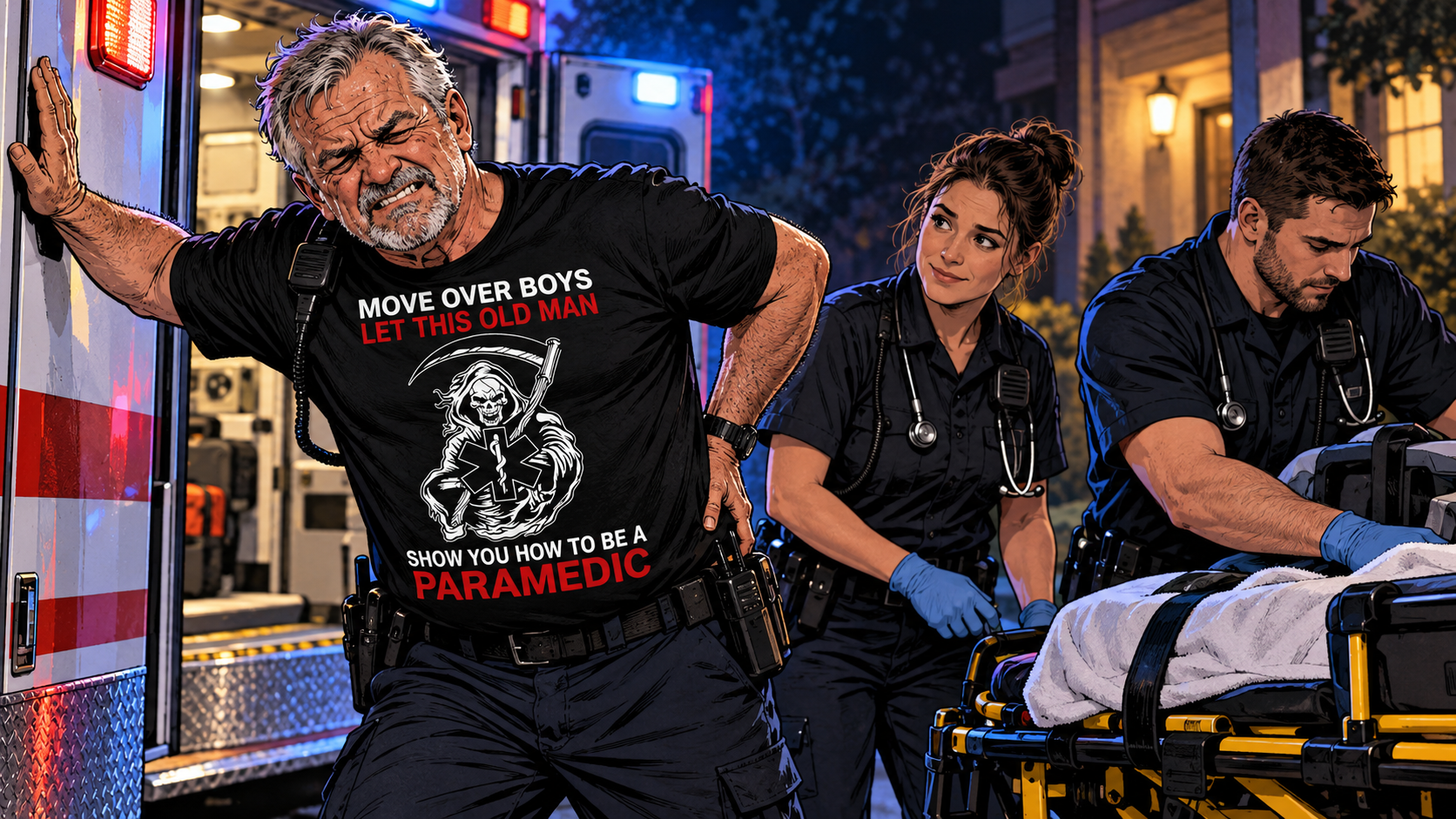
I understand the shirt.
There’s a certain satisfaction that comes from being the old medic who can walk into a chaotic scene, take control, and show the newer providers how the job is supposed to be done.
Experience matters. Time on the street teaches things no textbook, protocol update, or shiny new monitor can teach.
But experience can also become an excuse.
For years, EMS treated emotional suffering like a character flaw. PTSD was something you kept quiet. Depression was something you worked through. Asking for help meant somebody might decide you weren’t tough enough to wear the patch.
We’re finally getting past some of that stupidity.
It’s okay not to be okay. Reaching out doesn’t make you weak. It means you’ve recognized a problem before it spreads into your family, your relationships, your patients, and the rest of your life.
Good for us.
Now Let’s Talk About the Body
And I’m talking to the old guys and gals here, too. The ones who have been doing this for twenty, thirty, or forty years and still believe they’re indestructible because they’ve managed to keep showing up.
You are not indestructible.
Neither was I.
Nobody else can tell you when it’s time to come off the unit. That decision belongs to you. I can’t tell another medic when their last shift should be. I only know when it was time for me—and I probably argued with the evidence longer than I should have.
I wasn’t mentally finished. My mind was still sharp. I could still assess a patient, recognize a sick one, make decisions, teach, and see problems coming before some people knew there was a problem.
But the body is part of the job, too.
And the body keeps score.
Every missed meal. Every bad night of sleep. Every twelve- or twenty-four-hour shift fueled by caffeine and whatever food could be acquired between calls. Every time you ignored the aching back, the shortness of breath, the rising weight, the blood pressure, or the fact that you were no longer recovering from a shift—you were merely surviving it.
That sixty-year-old body holding a gas-station burrito at 0300 doesn’t get a free pass because the brain still knows how to run a call.
I know. I’ve written about the burritos already.
This isn’t that article.
The Mirror Knows
This is about the provider—young or old—who keeps telling themselves they’re fine because admitting otherwise would require changing something.
You can lie to your boss.
You can lie to your spouse.
You can even lie to your doctor, although that’s a particularly stupid place to practice your storytelling.
But that face in the mirror?
It knows.
It knows how hard the stairs have become. It knows how long it takes to recover. It knows when you’re holding your breath, hiding the pain, avoiding the scale, skipping the appointment, or pretending that exhaustion is just part of getting older.
The mirror doesn’t care how many calls you’ve run. It doesn’t care how many rookies you’ve corrected. It doesn’t care that you were once the strongest person on the truck.
It knows what you’ve been doing to yourself.
And eventually, the receipts come due.
Mine came due with a CABG x4.
Don’t pay yours that way.
Take Care of Yourself Before You Need To
To the younger providers: take care of yourself now. You still have time to build better habits before years of neglect become a medical history.
To the old ones: stop using your experience as evidence that you’re immune to consequences. You’ve survived this long because you were lucky, skilled, stubborn—or some combination of all three.
None of that makes you bulletproof.
You don’t have to become a fitness model. You don’t have to give up every cheeseburger or pretend you’re going to enjoy eating boiled chicken and sadness. But you do need to understand that small decisions made repeatedly become your physical condition.
Walk more. Sleep when you can. Eat something that didn’t come wrapped in foil under a heat lamp. Get your blood pressure checked. Pay attention when your body starts giving you information instead of treating every warning sign like an inconvenience.
The job is hard enough without helping it wear you out.
There may come a time when you can still do the job mentally but cannot safely sustain it physically. That doesn’t mean you’re weak. It doesn’t erase what you’ve done. It means you’re human.
Coming off the truck isn’t always an emotional failure. Sometimes it’s the most responsible decision you can make—for your partner, your patients, and the people waiting for you at home.
It’s okay not to be okay in your head.
It’s okay to admit your body isn’t twenty-five anymore.
Take care of both while you still have a choice.
Because the goal isn’t to prove you can survive one more shift.
The goal is to still be here when the shift is over.