Somewhere along the way, EMS decided it needed a fancier name.
Apparently, Emergency Medical Services no longer sounded sufficiently educated, clinically advanced, or professionally important. So we rummaged through the academic costume closet, pulled out the word Paramedicine, awarded ourselves an honorary doctorate, hung a shiny new Eko stethoscope around our neck, and started congratulating one another on how far we had advanced.
There was no dissertation defense.
No measurable improvement in patient care was required.
Nobody had to explain why educational standards still vary wildly, why continuing education remains a yearly scavenger hunt for easy credits, or why some agencies staff ambulances with little more than optimism, a valid driver’s license, and somebody who once watched an episode of Emergency!
We just changed the nameplate on the door.
And damn, doesn’t it look impressive?
The Graduation Ceremony Nobody Earned
Before somebody clutches their pearls and reports me to the International Academy of Important-Sounding EMS Words, let me be clear:
I am not opposed to the word paramedicine.
Words matter. A profession should be able to describe what it does, where it is going, and why the work requires more than a pulse, a protocol book, and a willingness to get cussed out beside a dumpster at three in the morning.
But a new word does not create a new profession.
Right now, paramedicine suggests EMS has completed a professional transformation that large portions of EMS have not even started. It borrows the language, wardrobe, and appearance of mature healthcare professions without consistently demanding the education, clinical accountability, research, mentorship, working conditions, or patient outcomes that should come with that status.
The honorary doctorate is hanging on the wall.
The expensive stethoscope is around our neck.
Underneath the new accessories, however, we are still sitting in the same battered folding chair—short-staffed, inconsistently educated, questionably supervised, and arguing over whether taking a manual blood pressure is really necessary.
Please Hold Your Applause
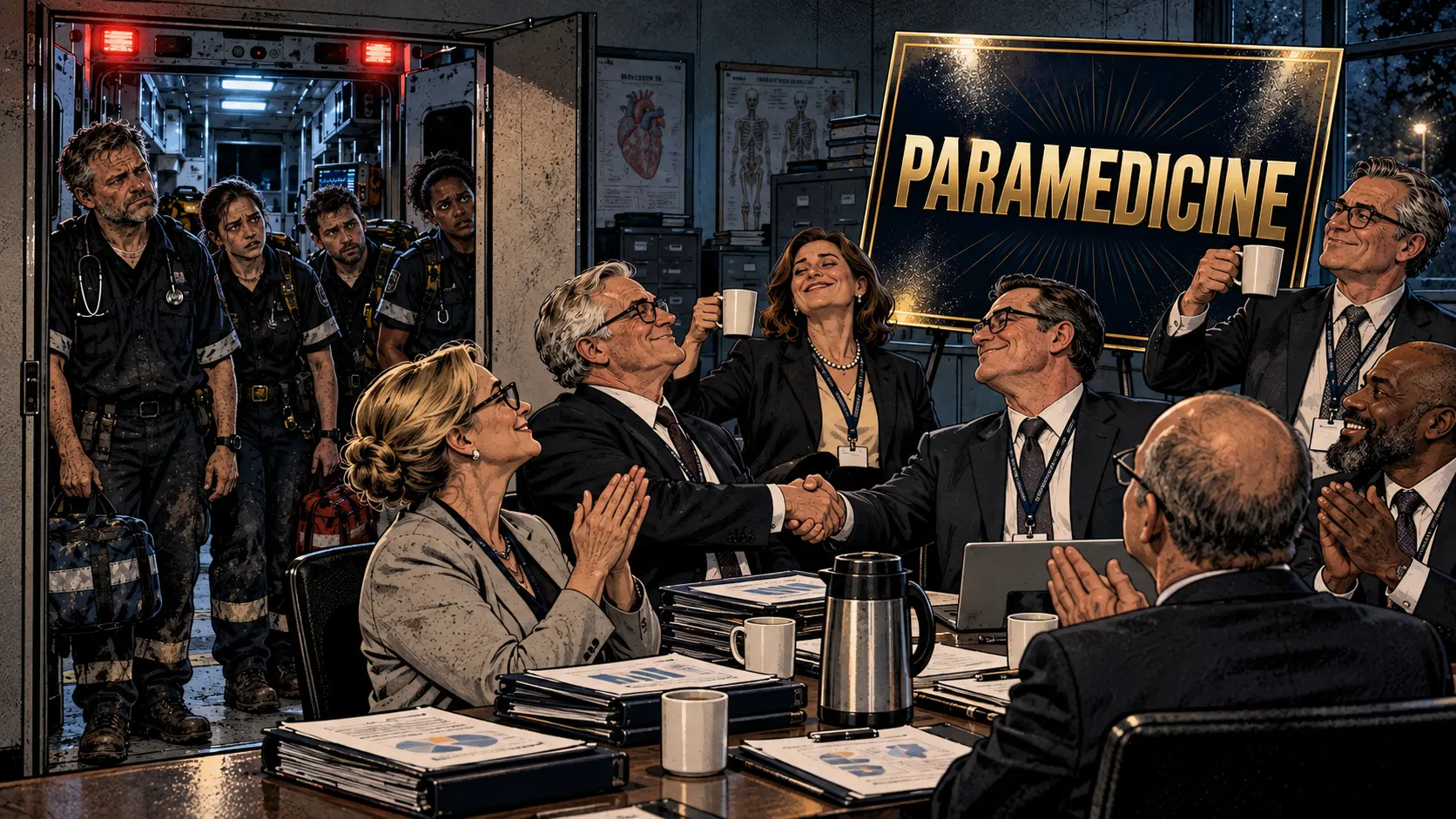
You can picture the meeting.
A conference room full of academics, administrators, consultants, and professional alphabet collectors sits around a polished table. The presentation is titled something like:
Nobody is entirely sure what the hell it means, but the slide has arrows, circles, and six shades of blue, so clearly someone has done serious work.
Someone says paramedicine with the reverence normally reserved for a new religion, a large grant award, or a station coffee machine that has not broken yet.
Heads nod. Hands clap. Everybody takes turns congratulating everybody else for being in the room.
Meanwhile, a few dirty, sleep-deprived medics are standing outside the door, staring through the glass like they have stumbled into a cult meeting.
They are wondering whether anybody inside knows that Medic 12 has been out of service for three weeks, their last continuing-education class was forty-five minutes of clicking NEXT, and the new employee riding third today still cannot assemble the oxygen regulator without adult supervision.
The people inside are celebrating the graduation ceremony.
The people outside are still doing the damned coursework.
The Word Is Not the Work
Real professional progress should be visible where the work actually happens.
It should show up in the back of the ambulance, in the patient’s living room, during the emergency-department handoff, and at three in the morning when the crew has been awake too long and is still expected to make a sound clinical decision.
Does adopting the word paramedicine make clinicians more capable? Does it improve initial education, strengthen field training, provide meaningful mentorship, or improve clinical judgment and patient outcomes?
Does it give the person caring for the patient better equipment, better support, and enough time to use either one properly?
If the answers require seventeen minutes, four buzzwords, and a diagram shaped like a wagon wheel, the transformation is probably happening in the vocabulary instead of the care.
Changing the title on a PowerPoint slide does not change what happens when the rear doors close.
The Credential Is Not the Competence
EMS loves a credential.
Add a few letters after someone’s name and suddenly the room gets quieter. Give them a conference badge, hand them a microphone, and let them say evidence-based practice three times before lunch, and we begin treating them as if they descended from the mountaintop carrying two stone tablets and a new set of protocols.
But competence is not a font choice.
It is not a conference badge, a job title, an expensive stethoscope, or an email signature long enough to require its own table of contents.
Competence is what remains when the algorithm stops being helpful and the patient refuses to read the textbook.
It is recognizing that something is wrong before the monitor confirms it. It is knowing when the protocol fits, when it does not, and when you need to slow down and figure out the difference.
It is understanding that the monitor is a tool, not an oracle—and the patient did not agree to cooperate with your test question.
A legitimate professional identity should make competence harder to fake and easier to develop. It should demand better education, stronger mentorship, meaningful clinical standards, and honest feedback. It should reward people who can think—not merely those who can repeat the approved language while wearing the correct concerned expression.
The Eko Stethoscope Effect
There is nothing wrong with owning good equipment.
If you want the shiny electronic stethoscope, buy it. Enjoy it. Put your name on it before somebody from night shift permanently reassigns it.
But the stethoscope is a tool, not a personality—and it certainly is not proof of clinical mastery.
A five-hundred-dollar stethoscope hanging around the neck of someone who never properly assesses the patient is just an expensive necklace.
That is where paramedicine risks landing.
We adopted the accessory before developing the substance it supposedly represents. We want the appearance of advancement without enduring the uncomfortable work required to advance.
We want professional recognition without universal professional standards. We want expanded clinical authority without consistently demanding clinical competence.
We want a seat at healthcare’s grown-up table while parts of our own industry still treat education as an inconvenience, mentorship as an optional courtesy, and burnout as a personal character flaw.
Then we act shocked when the rest of healthcare does not automatically treat us like the physician-adjacent clinicians our latest conference brochure says we are.
Same Circus, Nicer Sign
Calling it paramedicine does not magically repair the system.
The ambulance is still held together with duct tape, zip ties, and the collective denial of middle management.
The staffing plan is still based on the belief that employees do not require sleep, food, family time, or functional lumbar spines.
The continuing-education program still rewards attendance more reliably than mastery.
The orientation process still occasionally boils down to, “Here are the keys. Try not to wreck it.”
The struggling new clinician is still handed to whichever experienced provider forgot to avoid eye contact with the supervisor.
The excellent preceptor is still expected to mentor, evaluate, document, encourage, correct, and occasionally perform an exorcism—all while completing the regular workload without additional time or meaningful support.
But now we call it paramedicine, so apparently everything is fine.
That is not professional development.
That is putting a bow tie on a raccoon and introducing it as the department chair.
What Would Make Paramedicine Real?
If paramedicine is going to mean something, it must require something.
It should mean better preparation—not simply cramming more material into the same inadequate classroom hours and hoping PowerPoint can perform another miracle.
It should mean education that develops clinical reasoning instead of teaching students to hunt for keywords on an examination.
It should mean field training that determines whether someone can actually care for a patient—not whether they survived three shifts without damaging the ambulance or offending the charge nurse.
It should mean continuing education that identifies weaknesses, sharpens judgment, and keeps clinicians current—not another annual pilgrimage through recycled slides while an instructor reads every word aloud as if the audience suddenly forgot how literacy works.
It should mean learning from mistakes without turning every honest conversation into a blame hunt, disciplinary ambush, or liability-management ritual.
It should mean protecting field clinicians from systems that demand professional performance while providing bargain-basement staffing, broken equipment, inadequate rest, and leadership that has not touched a patient since flip phones were considered advanced technology.
And above everything else, it should mean the patient remains the final examination.
Not the presentation. Not the press release. Not the organizational chart. Not the new logo. Not the number of people who applauded when the initiative was announced.
Did the patient receive better care? Was the clinician better prepared? Did the system support sound clinical decisions? Did the next crew inherit something stronger than what we had yesterday?
Those questions are not nearly as glamorous as unveiling a new professional identity.
They are also the only questions that really matter.
Keep the Word—But Earn the Degree
I am not suggesting we throw paramedicine into the dumpster behind the station.
Keep it.
It may eventually become a useful name for what this profession is capable of becoming. But use it as a standard we must meet—not an award we presented to ourselves for showing up.
Make us defend the dissertation.
Make us demonstrate the competence.
Make us prove that the education is better, the clinicians are stronger, the systems are healthier, and the patients are receiving better care.
Then we can hang the degree on the wall.
Until then, paramedicine is mostly an honorary doctorate from a university we invented, presented during a graduation ceremony we organized, while wearing academic robes we ordered from Amazon.
At least the Eko stethoscope is real.
The next time somebody announces a shiny new EMS transformation, ask three plain questions:
What has actually changed?
How does it improve patient care or field practice?
What evidence demonstrates that it worked?
If nobody can provide a direct answer without reaching for a buzzword, a strategic framework, or another forty-seven-slide presentation, the folding chair is still exactly where we left it.
Paramedicine can represent meaningful professional progress.
But only when we stop congratulating ourselves long enough to do the unglamorous work required to make the word true.
Otherwise, congratulations.
We gave ourselves an honorary doctorate, bought a shiny new stethoscope—and rebranded the same old folding chair.