Welcome back to the bench seat — some of you have been here before and already know where this is going. Some of you are brand new and have no idea what you just sat down in the middle of. Either way, glad you’re here.
I’ve told this one a few different ways over the years. Different rooms, different faces, different shifts. Some folks took it and ran with it. Some nodded along and forgot it by the time they hit the parking lot. And somewhere out there — and you know exactly who you are — somebody’s still standing over a patient with a pen in their hand wondering why things aren’t going according to the card.
So we’re going around one more time.
For the new providers just now seeing this job for what it really is — welcome. Sit still. This part matters more than you know yet.
For the veterans who’ve already got it — appreciate you. Pass it on.
For the ones who haven’t quite landed on it yet — no judgment. But pay attention this time.
And for the folks with the impressive credentials and the conference lanyards who want to debate the pedagogy of protocol-based education — respectfully, pull up a chair too. The bench seat’s got room. Just know this conversation was happening long before the PowerPoint slides, and it’ll be happening long after.
You’ve got your sheets. Your laminated cards. Your color-coded little lifelines somebody built in a nice quiet office with decent coffee and zero screaming in the background.
Airway. Breathing. Circulation.
Say it nice. Say it clean. Say it like it means something.
Now say it again while somebody’s actively trying to die in front of you and tell me how poetic it feels.
I’ve watched brand new providers — good ones, too — stand there and run OPQRST like they’re defending a thesis.
Measured. Calm. Professional.
Completely missing the fact their patient is circling the drain.
“Onset? What were you doing when this started?”
…son.
His onset is right now. His provocation is life catching up with him. His radiation is everywhere. His severity is yes.
And you’re still writing on your glove with a sharpie like that’s gonna save him.
Put it down. Look at him. He’s telling you everything you need to know — you just have to actually see it.
And before somebody gets wound up in the back —
No. I am not telling you to go rogue.
I am not telling you to freelance this job and make it up as you go. That’s how you end up explaining yourself to people in suits who’ve never touched a patient but will absolutely take your patch and your paycheck without blinking.
Protocols exist for a reason.
They are written in blood. In bad calls. In the kind of mistakes that don’t get do-overs.
But here’s where it gets uncomfortable — and good. It should feel uncomfortable.
Following vs. Understanding
Following a protocol and understanding a protocol?
Not the same thing. Not even close.
You can train a parrot to follow steps. Takes about a week. You cannot train a parrot to manage a scene where nothing lines up, the information’s garbage, and everybody’s saying something different.
That’s you now. That’s the job.
Because when it goes bad — and it will — you’re not flipping through some mental checklist like a recipe card.
You’re in the back of a moving unit, monitor chirping like it’s personally disappointed in you, and your hands have that fine little tremor — you know the one — where you look steady but inside you’re already reading the situation for what it actually is.
That’s not weakness.
That’s awareness.
That’s you understanding the stakes.
The Five Rights, Under Pressure
Take your Five Rights.
Patient. Drug. Dose. Route. Time.
Clean. Simple. Makes sense. Whoever put that together deserves a handshake and a decent cup of coffee.
Now try doing it while your IV just blew, your patient’s pressure is dropping, your partner needs a set of vitals, and dispatch is asking if you’re available for another call.
You still do it. Every time. Non-negotiable.
But let’s be honest with each other — it’s not clean. It’s not calm.
It’s controlled panic.
The controlled part? That’s your training doing exactly what it’s supposed to do. The panic? That’s your brain correctly identifying that this matters.
Trauma Doesn’t Read the Textbook
Trauma? Yeah. Trauma’s where the gap between the textbook and the street gets real wide, real fast.
Textbook says head-to-toe. Nice and orderly. Systematic. Like a guided tour of the human body.
Reality is glass in your gloves, diesel in the air, somebody calling out from three different directions, and a patient in a position people aren’t meant to be in.
You are going straight to whatever is killing them right now.
Because dead patients do not award partial credit for good organization.
So you stop the bleed. You fix the airway. You buy time.
Then — then — you can be thorough about it.
And those mandatory actions.
“Stops bleeding. Applies oxygen. Maintains spinal immobilization.”
Reads real confident on paper.
Out here you’ve got two hands — maybe four if your partner isn’t buried in something else, which is not always a given — and about ten problems all competing for your attention at the same time.
So you prioritize.
Not because you’re skipping protocol.
Because you’re actually using it.
Big difference. Significant difference. The kind of difference that matters when things get complicated.
Tools, Not Scripture
Now here’s the part that makes people shift in their seats a little.
Protocols are tools.
Not religion. No matter how many people treat them like scripture and get uncomfortable when somebody says that out loud in a room with fluorescent lighting and a projector.
You don’t worship a hammer. You use it. You know what it’s for. You know when to set it down.
Same principle here. Use the protocol. Lean on it. Trust it.
But don’t hide behind it when the scene stops looking like the classroom.
I’ve watched good medics freeze. Smart ones. Technically sharp ones who knew their material cold.
So focused on doing it correctly that they forgot to do what was needed.
The checklist locked them up while the patient kept getting worse.
That’s true whether you’ve got thirty days on the job or thirty years.
Don’t be that medic.
Know the Why
So here it is, plain as I know how to say it —
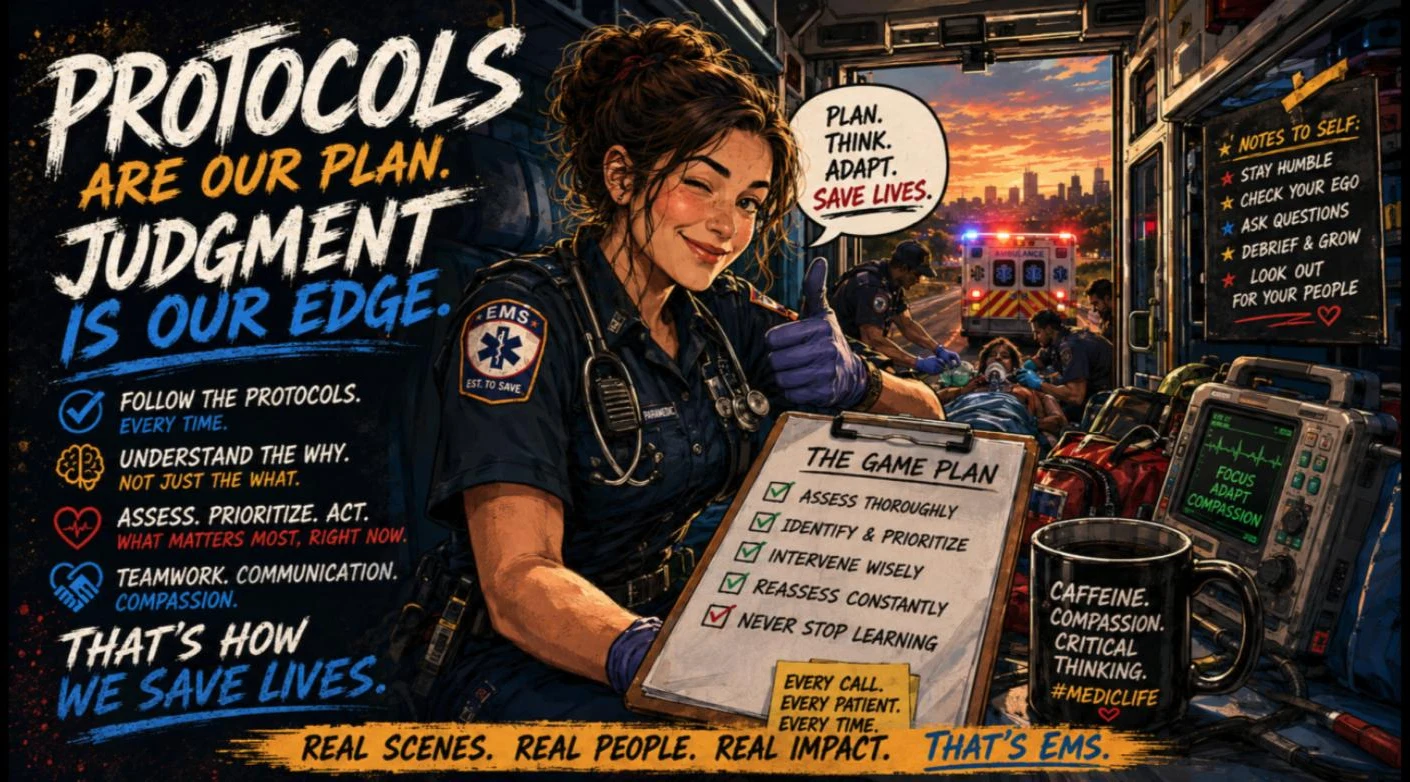
Follow your protocols. Every time. No freelancing. No cutting corners. That foundation is what keeps your patient safe and your practice defensible.
But don’t just memorize the steps…
Understand them.
Know the why. Know what each piece is protecting against. Know what happens when it gets missed — and when you can’t get to everything at once, know what matters first.
Because when this job goes loud — and it will, and it won’t ask your permission — you are not going to have time to think about the list.
You’re going to act on what you actually know.
Make sure what you know runs deeper than the order of the steps.
Anyway. Welcome to the bench seat.
Drink your coffee before it gets cold. (Or don’t.)
It already tastes like yesterday’s shift.
But you showed up anyway.
And that counts for something.