
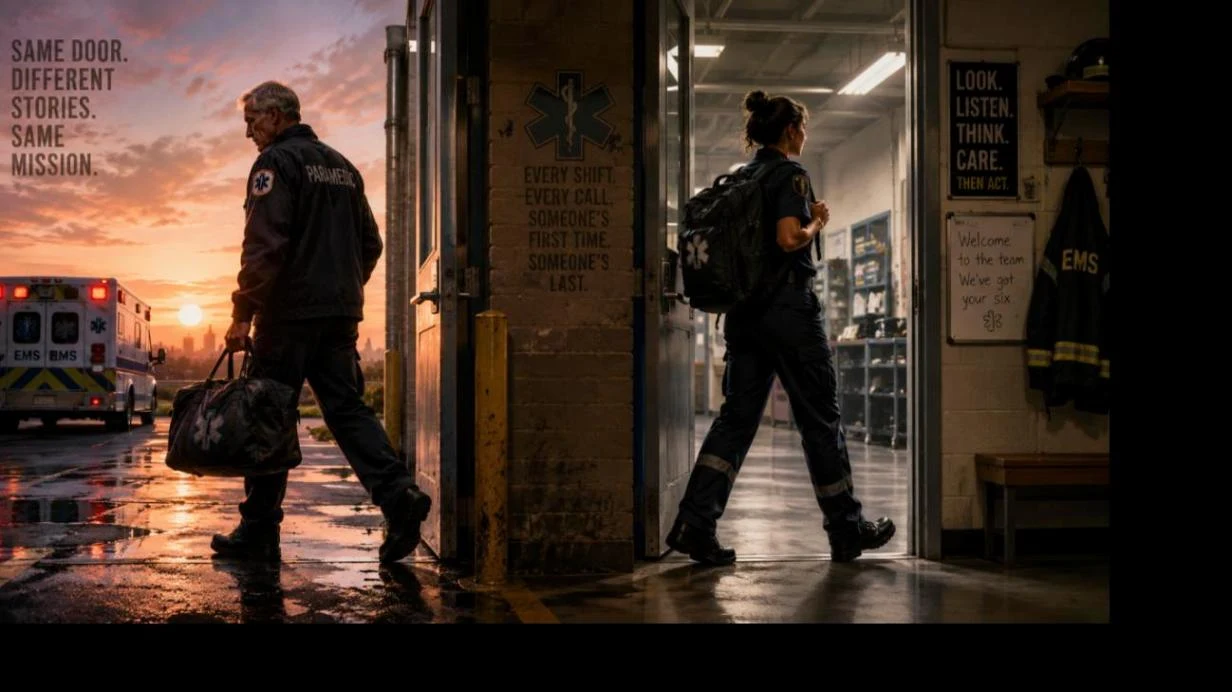
I have watched good medics walk out that door so many times I stopped counting somewhere around the Clinton administration. Some of them slammed it. Most of them just eased it shut behind them like they were trying not to wake anybody up.
Turned in the badge. Said something vague. Disappeared.
And the station just… absorbed it. Like it always does. Like losing people is just part of the operational tempo and not a five-alarm fire we’ve been ignoring since before some of your preceptors were in diapers.
Let me tell you what the workforce retention task force — the one with the catered lunch and the nice laser pointer — is not going to tell you.
We are hemorrhaging providers at both ends simultaneously. The veteran at year six and the new kid at month eighteen. Different wounds. Different causes. Different autopsies.
Same body count.
And every single time — every. single. time. — somebody in a collared shirt stands up at a podium and says the same thing.
Raise the pay. Go from 24/48 to 24/72 or 48/96
Lort, have mercy y’all.
Two Medics Traded Places
I have known medics making eighteen dollars an hour at a quiet rural station who were perfectly content human beings. Sleeping between calls. Home by 0700. Grass cut. Kids at the bus stop. Sanity reasonably intact.
I have known medics pulling thirty-plus an hour running so hard the rig smells like sweat and a hot Monster Pipeline Punch by hour ten of a twelve-hour shift that nobody honest is calling twelve hours.
And here’s the part that should keep you up at night — those two medics have traded places. Chased the money. Chased the quiet. Back and forth. And you know what they found?
Neither one of it fixed what was actually broken.
Think about that a sec. I’ll wait…
Withdrawal, Withdrawal, Withdrawal
The medic who burns out at year six — and I have watched this happen more times than I care to count — didn’t burn out because the check was wrong.
He burned out because this job is a slow withdrawal from an account nobody was making deposits into.
Every bad call. Every kid that didn’t make it. Every family you had to look in the eye with nothing useful to say. Every lift assist. Every system failure dressed up as a provider failure. Every supervisor who couldn’t find the unit on a map but had plenty of opinions about your patient care report.
Withdrawal. Withdrawal. Withdrawal.
No deposits.
No real peer support with actual teeth. No honest conversation about what this work does to a human being over time. Just a laminated pamphlet about the Employee Assistance Program and a suggestion to “talk to somebody” from a shift commander who schedules mandatory overtime with one hand and signs wellness initiative memos with the other.
That medic loved this job once. You could see it. The kind of love that makes a person come in early and stay late and actually give a damn whether the new kid learns something or just survives the shift.
And then one day the lights behind his eyes just went out.
Still showing up. Still charting. Still answering the radio.
But gone.
We call that burnout like it’s a blown fuse.
It isn’t.
It’s years of the job eating somebody alive in small quiet bites while everybody looked the other way because the unit still posted a response time inside the contractual threshold.
The Eighteen-Month Story
Now.
The eighteen-month provider.
This one’s going to sting a little. Fair warning.
Some of those eighteen-month providers didn’t burn out.
They timed out.
There is a difference and it matters and we need to stop pretending otherwise because conflating the two is an insult to the medic who genuinely gave this job everything he had until it broke him.
EMS has always fed the healthcare pipeline. I know that. I accept that. Some of the finest nurses and physicians I have ever seen work an emergency department started on a medic unit and you can tell — you can tell — because they actually look at the patient before they look at the monitor and they don’t lose their minds when the room gets loud.
You want to use this job as a launchpad to nursing school or medical school or a PA program?
More power to you. Mean that sincerely. Go be excellent. Take what the streets put in you and do something remarkable with it.
But here’s what I need from you while you’re still here.
Do the damn job.
Not the checkbox version. Not the ghost shift where your body is on the unit and your brain is reviewing NCLEX flash cards. Not the I’m-just-here-for-the-clinical-hours performance of being a paramedic while the actual work of being a paramedic happens somewhere just past your peripheral vision.
Because that patient on your stretcher right now does not know your application deadline. Does not know about your personal statement. Does not know you’ve got your letters of recommendation locked and loaded and you’re just running out the clock until something better starts.
That patient called 911.
And somebody showed up.
They deserve that somebody to have actually shown up.
All the way.
Eyes up. Brain engaged. Fully present.
Not auditioning for the next thing while a real human being is having the worst day of their life on your bench seat.
What They Carry Out the Door
Here’s a quiet part they don’t talk about in those feel-good corporate weekend retreats.
The eighteen-month provider who leaves before the trauma fully lands — they don’t leave clean. They go to nursing school or wherever they’re going and they think what they’re carrying is just stress. Just the learning curve. Just the adjustment period everybody talks about.
Some of them are right.
Some of them are carrying a call from fourteen months ago that they never named, never processed, never talked to a single living soul about — and it is waiting for them. Patiently. The way bad things wait. And it will find them at 2 AM some random Tuesday in year three of their nursing career when a patient codes and something misfires in the back of their brain that has absolutely nothing to do with the present moment.
The job gets in you whether you signed up for that or not.
That is not a metaphor. That is occupational physiology.
What Changed, and What Didn’t
So what changed between the veteran burning out at year six and the new kid flaming out at month eighteen?
The call volume math got obscene. The Bravo Sierra to actual-medicine ratio got worse. The social media performance of EMS identity got so loud it drowned out the actual culture of mentorship that used to pass real knowledge from one generation of providers to the next. Leadership kept promoting the wrong people for the wrong reasons and calling it succession planning.
What didn’t change?
The 0400 call where everything you know either shows up or it doesn’t. The weight of the silence driving back to quarters. The look on a family’s face. The cost of carrying what this job puts in you.
That hasn’t changed one bit.
Neither has the price of ignoring it.
We keep trying to fix a psychological wound with an economic bandage.
Forty dollars an hour and a new fleet and a wellness app with a meditation timer.
And the people bleeding out know exactly what that’s worth.
Actionable Takeaway
So here’s what I’m asking.
Not from a podium. Not from a task force. Not from a conference room with a whiteboard and a grant-funded action plan.
From the bench seat.
Find the medic in your station who used to love this job and doesn’t anymore. You know who I’m talking about. You’ve known for a while.
Buy them a cup of coffee.
Don’t ask how they are doing. Don’t hand them a pamphlet. Don’t make it a meeting.
Just sit there with them for a minute.
And actually listen to what comes out.