Abstract
This paper examines the widening gap between contemporary EMS education and practical patient assessment skills observed among newly hired Emergency Medical Technicians entering the workforce.
Through thirty-six years of field experience, quality improvement review, employee orientation, and direct observation of new EMS personnel, a concerning trend has emerged: students are increasingly proficient in operating diagnostic equipment while demonstrating decreasing proficiency in fundamental patient assessment skills.
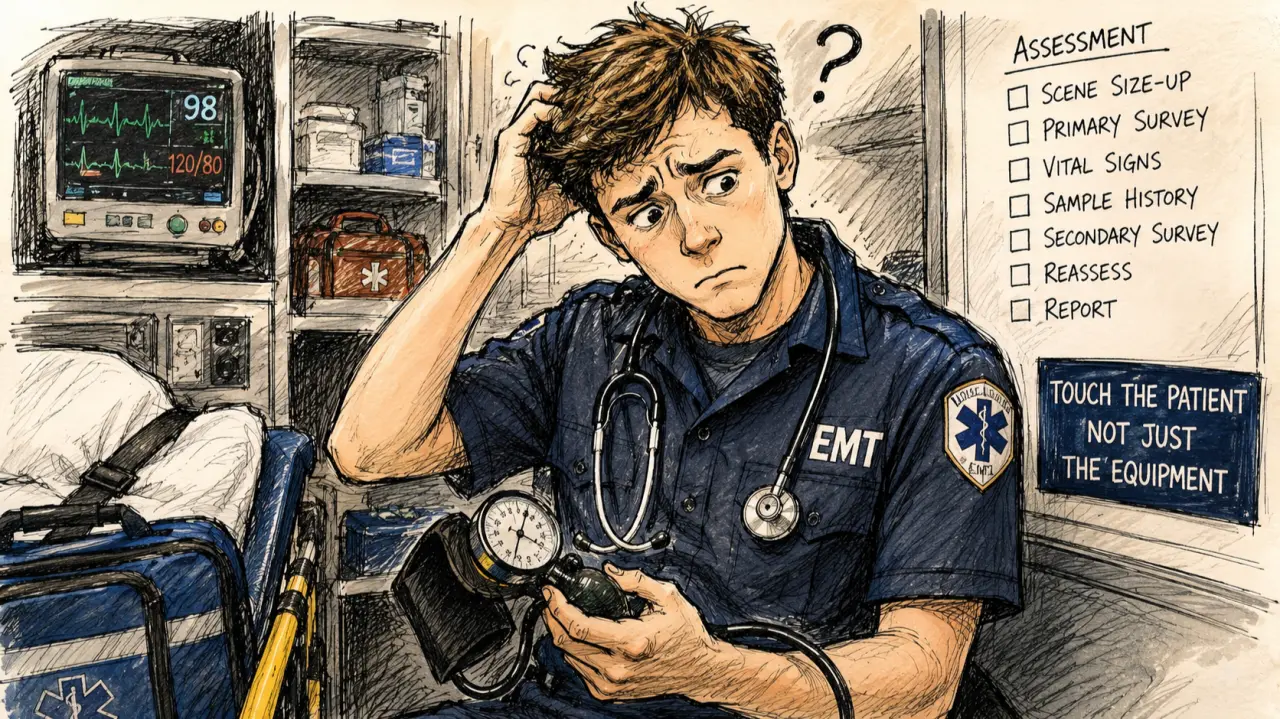
Particular emphasis is placed on manual blood pressure acquisition, pulse assessment, tactile examination, and the development of clinical judgment through direct patient contact.
Findings suggest that current educational models may inadvertently prioritize examination performance and technology utilization over experiential assessment skills.
Introduction
For the past thirty-six years, I have served in various roles throughout Emergency Medical Services including field provider, educator, quality improvement reviewer, and training coordinator.
In recent years, a recurring observation has emerged during orientation and onboarding of newly hired EMS personnel. Many graduates demonstrate difficulty performing fundamental assessment skills including manual blood pressure acquisition and pulse assessment despite successful completion of initial EMS education programs.
To further evaluate assessment competency, participants are routinely instructed to obtain a radial pulse from the author’s left wrist.
Most successfully report locating a pulse.
This finding is noteworthy because the author no longer possesses a left radial artery.
The artery was surgically harvested during coronary artery bypass surgery and currently resides elsewhere.
Only a minority of participants correctly identify the absence of a pulse.
This observation suggests a tendency toward reporting expected findings rather than observed findings.
Nineteen people found a pulse that does not exist. One kid said, “I can’t find it.” I know exactly where my money’s going. The goal was never to find what you’re supposed to find. It’s to find what’s actually there. Everything else is just guessing with confidence.
Discussion
Contemporary EMS education has achieved significant advancements in curriculum design, simulation methodology, accreditation standards, educational outcomes assessment, and evidence-based instructional practices.
These developments have contributed substantially to the professionalization of EMS education.
The author acknowledges the value of advanced academic preparation among EMS educators and program administrators.
Save the emails. I’m not anti-education. Not anti-degree, not anti-Master’s, not anti-Doctorate. Some of my best friends have letters after their name. We need those folks. Somebody’s got to understand Bloom’s Taxonomy, accreditation, outcomes assessment—because Lord knows most paramedics would rather eat broken glass than sit through a curriculum committee meeting.
The Half-a-Toolbox Problem
An important question remains regarding the relationship between educational expertise and operational competency.
Many EMS educators follow a career progression that gradually reduces direct patient care responsibilities while increasing administrative and educational responsibilities. Consequently, individuals possessing the greatest educational expertise may possess limited contemporary field experience. Conversely, individuals possessing extensive field experience frequently possess limited formal educational training. As a result, neither group is fully positioned to close the assessment competency gap alone.
So pretty much what this is telling us: the folks who know education don’t always know the street, and the folks who know the street don’t always know education.
When’s the last time somebody making curriculum decisions had their hands on a patient that week? Not supervised a clinical. Not reviewed a chart. Actually touched somebody.
Now flip it. When’s the last time the field medic sat down and learned why the curriculum’s built the way it’s built?
Both sides working with half a toolbox, bragging like they brought the whole truck. Quit acting like two teams. You’re on the same call.
Proposed Solution
The author proposes increased investment in experienced field providers through formal instructor development programs emphasizing adult learning theory, curriculum development, educational evaluation, and instructional methodology.
Such an approach would allow experienced clinicians to combine operational expertise with evidence-based educational practices.
Take the old grumpy paramedic. You know the one. Bad back, bad knees, hearing’s questionable, got a collection of orthopedic injuries that basically qualifies as its own secondary assessment.
Send him to instructor school. Teach him the lesson plans, the evaluation methods, how adults actually learn. Then turn him loose on a classroom.
He already knows what matters. He’s been living it for twenty years. The educational tricks, you can teach. The experience, you can’t.
Outcome Measures
The effectiveness of educational programs should ultimately be evaluated through demonstration of competency among graduates.
“We already teach that.” Great. I’m glad. Seriously. Then answer me one question: why can’t so many of your graduates take a manual blood pressure? Not a hard one. Not trauma, not sepsis, not a dialysis patient circling the drain. A routine manual blood pressure. If we’re teaching assessment, if we’re teaching critical thinking, if we’re teaching hands-on medicine—why do so many freeze the second the NIBP throws an error?
And don’t tell me technology’s the future. Of course it is. I love the monitors. I love capnography, pulse ox, every fancy gadget we’ve collected over the years. But if your machine fails and your assessment fails right along with it, the machine was never the backup.
The proof’s not in the lesson plan. It’s in the student.
Conclusion
Current evidence suggests that increasing emphasis on direct patient assessment, tactile examination, clinical reasoning, and manual skill proficiency may improve educational outcomes among entry-level EMS providers.
Further integration of experienced field clinicians into EMS education may provide additional benefit.
Translation, for the folks keeping score at home: thirty-six years, a few thousand patients, and more bad station coffee than any human body should tolerate gets you exactly this.
Touch the damn patient.
Use your hands. Use your eyes. Use your ears. Pay attention.
The monitor’s a tool. The patient’s the assessment.
Further research is probably unnecessary.