It’s 02:17. Of course it is. Dispatch says: “Sick person, dizziness.” Which is code for “we have no clue and you’re about to earn your paycheck.”
You walk into some apartment that smells like cat pee, menthol rub, and old carpet—that special blend of “I haven’t opened a window since Clinton was president.” Patient’s on the couch, sweaty, pale, doing that tight little “I’m fine” voice while their eyes say “I’m not fine.”
Your partner’s already reaching for the fancy stuff. Monitor. SpO₂. BP cuff that auto-cycles like it’s trying to win a prize.
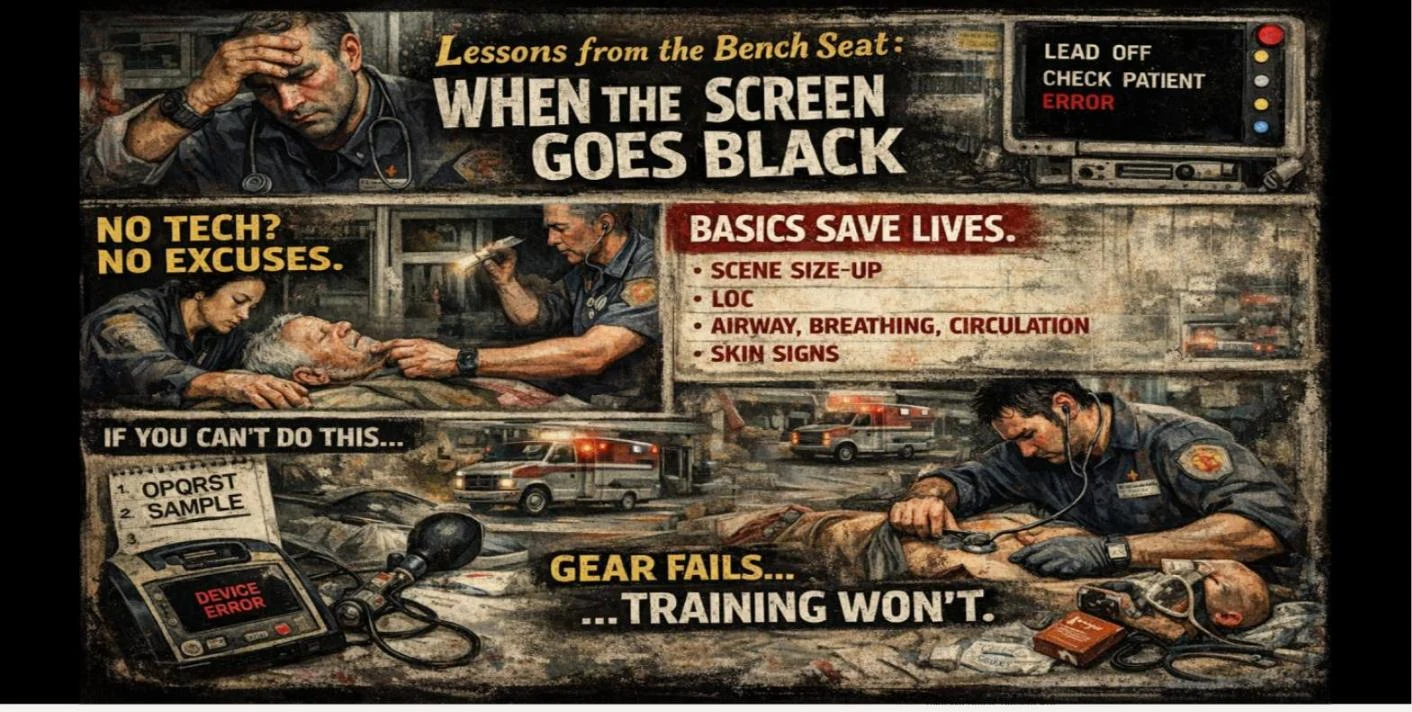
And then—because the EMS gods hate pride—the monitor won’t power on. Or it powers on and immediately throws a tantrum: “LEAD OFF.” “CHECK PATIENT.” “ERROR.”
Now what?
Here’s what: you don’t panic. Because you were trained like a grown-up—without bells and whistles first.
The Foundation Ain’t Sexy, But It Saves Your Ass
Everybody wants the cool toys. CPAP, IV pumps, ultrasound, fancy airway gadgets, whatever. But none of it matters if you can’t do the basics when the toys fail.
When tech craps out, you fall back on the assessment that never needs batteries: scene size-up—is it safe, what actually happened, how many patients, do I need more bodies here (and yeah, spine considerations if the story fits); general impression—sick or not sick, that gut punch feeling, the look, the posture, the work of breathing; LOC—alert, confused, responding to pain, or not responding at all; ABC like you mean it—airway open, breathing adequate, circulation not leaking out onto the carpet; and skin signs—not “uh… normal?” I mean cool and clammy, hot and dry, ashen, mottled, cyanotic. Your hands can read a patient faster than a screen can.
And the big one nobody respects enough until it bites them: transport decision. Early. Not after you’ve played twenty questions and taken three sets of vitals and rearranged the living room. You decide early if this is a load-and-go problem.
“But How Do I Know Without the Monitor?”
Because humans did EMS long before Bluetooth, bro.
You wanna know if they’re perfusing? Look at skin. Check a radial pulse. Watch mentation. Cap refill if you must—and don’t marry it, it’s a sketchy metric.
You wanna know if they’re working too hard to breathe? Can they speak full sentences? Are they tripod-ing? Retractions? Nasal flaring? Accessory muscles pulling like they’re doing deadlifts?
You wanna know if their story stinks? Use OPQRST and SAMPLE like a crowbar. Onset, provocation, quality, radiation, severity, time—then dig into meds, allergies, history, last intake, events. And don’t forget the obvious stuff people miss because they’re chasing numbers: what’s the chief complaint, and what’s trying to kill them first?
Real Talk: The Patient Doesn’t Care About Your Equipment
Your patient doesn’t give a damn if you can quote monitor waveforms. They care that you recognized they were a priority patient, managed airway and breathing and circulation, controlled bleeding if it’s trauma, treated shock like it’s real (because it is), and reassessed instead of getting hypnotized by your first impression.
And yeah—mandatory actions matter because missing one is how people die, and how you fail exams and get wrecked in QA. Controlling bleeding, good CPR, proper oxygen setup, clearing for hazards before shocking, medication five rights, aseptic technique—that’s bread-and-butter, not extra credit.
The Bench Seat Rule
Here’s the rule I want tattooed on every new provider’s brain: if you can’t run the call with nothing but your brain, your hands, a stethoscope, and a manual BP cuff… you don’t own that call. The equipment does.
Because one day you’ll be in the back, sweat sliding down your spine, radio squawking, family screaming, and the screen will go black.
And if your foundation’s solid? You’ll just shrug, take a manual BP, feel a pulse, watch the chest rise, make the call: “We’re moving.”
If your foundation sucks? You’ll stare at dead plastic like it’s gonna save you.
Anyway—keep chasing the cool stuff later. First, get savage at the basics. That’s what keeps patients alive when the toys quit on you.
—OGP