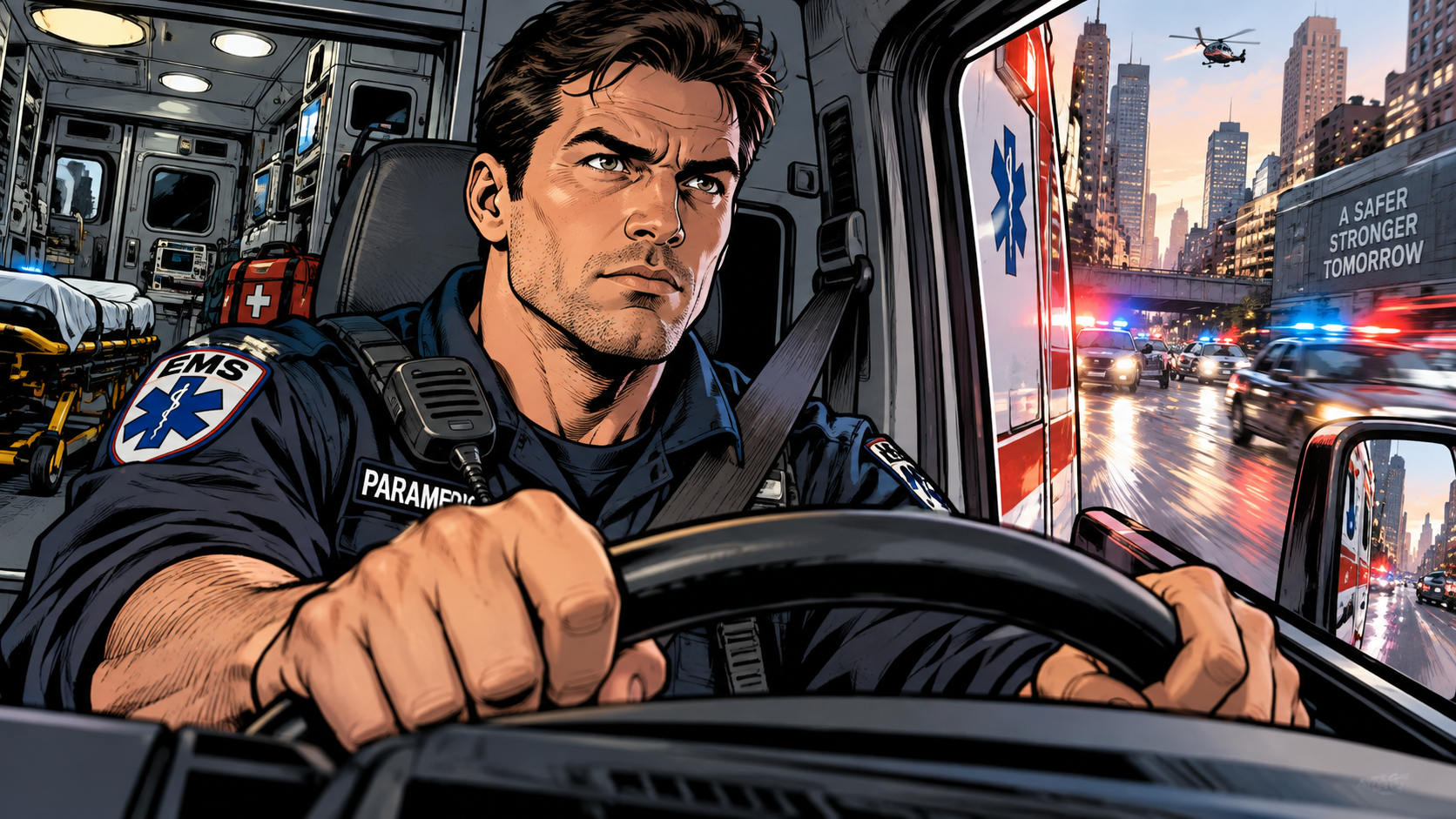
Somewhere between the scene and the hospital, the most important procedure on the truck is happening.
Nobody in the back is performing it.
The person in the left seat is.
I know. “Ambulance driver.”
Some providers hear that and immediately feel the need to correct somebody. A nurse. A police officer. A patient. Some sweet old lady who has no idea whether the person standing in front of her is an EMT, Paramedic, Critical Care Paramedic, or an Uber driver with a radio.
Don’t be a jackass.
Most people can’t tell the difference between our certifications. They know we showed up in an ambulance. They know we’re taking somebody to the hospital. “Ambulance driver” is usually the word they have available.
And when you’re behind the wheel, you are driving the ambulance.
That isn’t an insult.
That’s a responsibility.
The Left Seat Is Part of Patient Care
When you climb behind the wheel, you haven’t stopped being a clinician. You’ve taken responsibility for a different part of the patient-care process.
Your patient is in the back.
Your partner is working around that patient.
There may be an airway being managed, an IV being started, a medication hanging, a ventilator cycling, or a provider trying to perform a procedure while the vehicle is moving.
Every start, stop, turn, lane change, and decision affects what happens behind you.
A hard stop can turn a controlled airway into a problem.
A fast corner can send a provider into a cabinet.
A careless lane change can turn a transport into a trauma call.
You don’t have to be reckless to hurt somebody. You only have to forget that the patient is back there.
The best ambulance driver gives the crew in the back a stable platform to work from. Smooth starts. Smooth stops. Appropriate speed. Enough following distance to make decisions instead of apologies.
That’s not comfort.
That’s clinical support.
“I Already Know How to Drive”
I’ve sat through enough mandatory driving classes to recognize the look.
Phone in hand. Eyes half-open. Brain already somewhere else.
“I already know how to drive.”
No. You know how to drive your personal vehicle to the grocery store.
An ambulance is larger, heavier, slower to stop, more difficult to maneuver, and filled with people and equipment that matter. It has blind spots, a high center of gravity, and a patient in the back whose condition may be changing by the minute.
You’re not just moving a vehicle.
You’re moving a patient, a partner, a crew, and a responsibility.
That requires more than knowing where the accelerator and brake pedals are.
It requires scanning ahead. Maintaining a cushion of safety. Knowing the limitations of the vehicle. Communicating with the crew. Understanding that green lights still deserve caution and that other drivers are not required to be intelligent simply because your emergency lights are on.
Lights and sirens don’t repeal physics.
They don’t make other drivers see you.
They don’t turn an ambulance into an armored vehicle.
They announce that you’re asking traffic to cooperate. You still have to drive with due regard for everyone on the road—including the people in your own truck.
The Patient Doesn’t Care What Your Patch Says
The patient doesn’t care whether your patch says EMT, Paramedic, or Critical Care.
They care whether you arrive.
They care whether you move them without making things worse.
They care whether the person driving understands that every bump, sudden stop, and hard turn is being felt in the back.
And when they need definitive care, they care whether you can get them there.
The most advanced treatment in the world doesn’t help a patient who never reaches the hospital. The best clinical decision made in the back still depends on the unit getting to the next level of care.
That’s why ambulance driving isn’t a lesser skill.
You can be brilliant with a laryngoscope and dangerous behind the wheel.
You can manage a ventilator and mismanage an intersection.
You can recite every medication in the formulary and still injure your partner because you drove as if the patient wasn’t in the back.
Clinical competence does not stop at the rear doors.
Be the Best Damn Ambulance Driver You Can Be
So yes, I’m an ambulance driver.
Say it again if you need to.
I know what it means.
It means I’m responsible for what happens between the scene and the hospital doors. It means my partner, my patient, my equipment, and every person sharing the road with me are depending on my judgment.
Learn the vehicle.
Know where the corners are.
Use your mirrors.
Use a spotter when backing.
Slow down at intersections.
Drive for the conditions—not your ego.
And when you’re sitting in a mandatory CEVO class thinking you already know everything, remember that the person in the back is trusting you with more than the steering wheel.
They’re trusting you to get them there.
The patient in the back doesn’t care how impressive you looked on the scene.
They care whether you can get them to definitive care without becoming part of the emergency.